By Godgift Harris
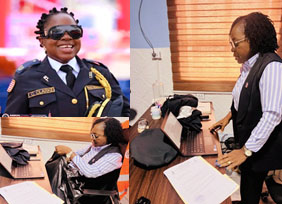
The resignation of Deputy Commissioner of Police Cecelia G. Clarke as Police Spokesperson, has exposed deep-seated institutional tensions within the LNP, raising troubling questions about internal governance, gender equity, and leadership cohesion at law enforcement agency.
In a formal letter dated Wednesday, February 18, 2026, Madam Clarke announced her decision to step aside from the highly visible spokesperson role after nearly two years.
She cited “persistent workplace discrimination, operational constraints, limited institutional support, and structural barriers that crippled the effective functioning of her office.”
While she remains a deputy commissioner of police, her resignation from the communications portfolio signals a broader crisis that the LNP can no longer ignore.
Madam Clarke, one of the few women to have served in such a senior and public-facing role at the LNP, said she undertook the responsibility with “integrity, vision, and a deep sense of professionalism,” to strengthen public trust and institutional transparency.
Her exit, however, suggests that those efforts were met with resistance from within.
Allegations of undermining and internal sabotage
Sources within the LNP, speaking on condition of anonymity, allege that Madam Clarke’s authority as spokesperson was repeatedly “undercut by internal actors, including a former spokesperson whose continued influence allegedly blurred lines of command and communication.”
According to sources, parallel briefings, conflicting statements, and informal back channel communications often contradicted or pre-empted Madam Clarke’s official pronouncements, eroding her credibility and confusing the public.
Madam Clarke’s resignation letter stops short of naming individuals, but it refers pointedly to “difficulties in team collaboration” and “recent developments” that made it untenable for her to continue.
These coded references, insiders say, reflect a pattern of institutional undermining that senior management failed to address decisively.
“If the police spokesperson cannot speak with the full authority of the institution, then the institution itself is compromised,” a senior security analyst told this newspaper.
“Public confidence depends on clarity and consistency. What we are seeing is symptomatic of a deeper leadership failure.”
Gender and power dynamics under scrutiny Madam Clarke’s departure has also reignited debate about gender inclusion and equity within the security sector.
In her letter, she alluded to “persistent workplace discrimination,” a charge that resonates in a male-dominated institution where women officers have long complained of marginalization and limited advancement.
Civil society organizations argue that Madam Clarke’s experience reflects a broader pattern in which qualified women are appointed to high-profile roles without the institutional backing necessary to succeed.
“Token appointments without power are not progress,” said a representative of a women’s rights advocacy group.
“When women are placed in leadership, but denied authority, resources, or respect, the system sets them up to fail.”
The LNP has yet to publicly respond to the discrimination claims or clarify whether an internal review will be conducted.
The silence, critics say, risks reinforcing the perception of an institution unwilling to confront its own shortcomings.
Institutional support in question, beyond gender issues, Madam Clarke’s resignation highlights chronic administrative and operational weaknesses within the LNP.
She cited limited institutional support and structural barriers that affected her office’s performance language that suggests budgetary constraints, staffing shortages, and bureaucratic inertia.
Effective police communication is not cosmetic; it is central to crime prevention, crisis response, and public accountability.
When the spokesperson’s office is hamstrung, misinformation thrives and public trust erodes.
Recent incidents in which police statements were delayed, contradictory, or absent altogether have already fueled speculation that the LNP’s communications architecture is dysfunctional.
“Communication is command,” said a retired police commander.
“If you cannot control the narrative with facts and transparency, you lose legitimacy. Madam Clarke’s resignation is a warning sign.”
Implications for public trust and reform Madam Clarke assures of her committed to a smooth transition and wishes the LNP success in fulfilling its mandate.
Yet, her parting appeal that the institution strengthens its systems to promote fairness, inclusion, professionalism, and a healthy workplace reads less like a farewell and more like an indictment.
For an institution tasked with enforcing the law and protecting citizens, unresolved internal conflicts carry serious consequences.
The public expects discipline, unity, and professionalism from the police; visible discord at the top undermines confidence on the streets.
As pressure mounts for accountability, observers say the LNP leadership must do more than appoint a new spokesperson. They must confront the allegations head-on, clarify command structures, protect officers from discrimination, and ensure that no individual former or current operates outside established authority.
Until then, Cecelia Clarke’s resignation will stand as a stark symbol of an institution struggling to reconcile its public mission with its internal realities.