By: Abraham K. Morris
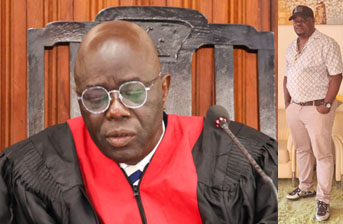
Two prominent Liberian public intellectuals, former Minister of Education- George Kronnisanyon Werner and Attorney-at-Law and journalist Al-Varney Rogers, have cautioned the Supreme Court against using its contempt powers to sanction offensive speech linked to controversial remarks by religious figure Prophet Key, arguing that such action risks crossing constitutional and international legal boundaries.
In separate but converging commentaries, both men strongly condemned the language attributed to Prophet Key, particularly remarks directed at the Chief Justice’s mother, describing them as morally indefensible and socially degrading. However, they emphasized that public outrage and ethical condemnation must not be confused with the scope of lawful state power.
Werner, drawing on his early exposure to legal reasoning through healthcare ethics studies at St. Joseph’s University in Philadelphia, framed his argument around the principle primum non nocere—first, do no harm—and the World Medical Association’s Declaration of Helsinki, which warns institutions against abusing power even when acting with good intentions.
“That lesson matters in Liberia today,” Werner wrote. According to Werner, while there is no constitutional value in personal abuse, particularly when private individuals are targeted, the law deliberately tolerates certain forms of offensive conduct to protect democratic discourse. Citing his experience teaching penology and social deviance, he stressed that “moral wrongfulness is not the same as legal culpability,” noting that constitutional intervention is justified only when speech causes concrete harm such as defamation, invasion of privacy, incitement to violence, or obstruction of justice.
Rogers advanced a similar constitutional analysis, anchoring his argument in Article 15 of the 1986 Constitution, which guarantees freedom of speech, expression, and the press. While acknowledging that these rights are not absolute, he argued that any restriction must be narrowly tailored and constitutionally justified. In his view, contempt proceedings based solely on offensive speech fail that test.
Both men pointed to the 2019 Kamara Abdullai Kamara Act on Press Freedom, which repealed criminal libel against the President, criminal malevolence, and sedition. The Act, they argued, represents a deliberate policy choice to end the criminalization of criticism and insult directed at public officials, even when such speech is harsh or vulgar.
Werner and Rogers also situated the controversy within a broader African and international legal framework, citing the 2010 Table Mountain Declaration on Press Freedom in Africa. The Declaration calls for the abolition of criminal defamation and insult laws, warning that they are often weaponized to suppress non-violent but offensive expression. Liberia’s continued adherence to such standards, they argued, requires restraint in the use of contempt powers.
A central theme in both commentaries was the distinction between personal dignity and institutional authority. Rogers argued that citing Prophet Key before the full bench of the Supreme Court risks transforming a personal grievance into an institutional confrontation.
“The alleged insult, which I frown upon, was directed at the Chief Justice as an individual, not at the Court as an institution,” Rogers said, maintaining that any remedy should lie in ordinary civil defamation proceedings rather than in the extraordinary contempt powers of the Court. Conflating personal dignity with judicial authority, he warned, could undermine judicial impartiality.
Werner echoed this concern, noting that although the Supreme Court possesses inherent contempt powers, those powers are exceptional and narrowly defined. “They exist to protect the administration of justice, not the dignity or reputation of judges,” he wrote. Contempt, he argued, should be reserved for conduct that disrupts proceedings, intimidates participants, defies lawful orders, or poses a real and substantial threat to judicial operations.
Rogers reinforced this position by referencing New York Times Co. v. Sullivan (1964), in which the U.S. Supreme Court held that public officials must tolerate even “vehement, caustic, and sometimes unpleasantly sharp attacks” unless made with actual malice. Protecting offensive speech, he argued, is essential to preserving robust democratic debate.
Applying these principles to the current controversy, both men concluded that while Prophet Key’s remarks were unacceptable, mere offense does not meet the legal threshold for contempt. Based on publicly available information, they said, there has been no showing that the speech obstructed justice, interfered with court functions, or incited violence.
“If such facts exist, they should be clearly articulated and tested in law,” Werner wrote. “Absent that showing, the use of contempt risks crossing a constitutional line.”
Both commentators stressed that their interventions were offered for scholarly and constitutional analysis, not as acts of disrespect toward the Supreme Court. Their shared warning was that expanding contempt powers to punish offensive but non-obstructive speech could chill public debate, particularly on sensitive issues such as land rights and displacement.
As Werner concluded, constitutional authority is ultimately demonstrated through restraint, not retaliation.