By: Godgift Harris
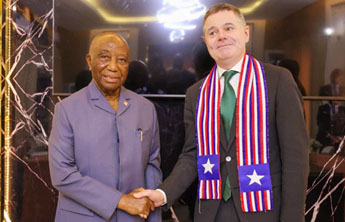
In a significant boost to Liberia development trajectory, President Joseph NyumaBoakai has held high-level discussions with Pascal Donohue, a senior official of the World Bank Group, in a move widely seen as reinforcing the longstanding partnership between Liberia and one of its most influential development partners.
The meeting, which took place at the President’s Rehab Offices in Paynesville, brought together senior government officials and members of the visiting World Bank delegation to advance conversations around Liberia’s development priorities.
The engagement highlights the Boakai administration’s renewed push to leverage international cooperation to drive economic recovery, infrastructure development, and improved living conditions for Liberians across the country.
Strengthening a historic partnership, the talks underscored the deep and evolving relationship between the Government of Liberia and the World Bank Group a partnership that has, over the years, supported critical sectors such as education, energy, governance and infrastructure.
During the meeting, Mr. Donohue reaffirmed the World Bank’s commitment to Liberia’s development goals, emphasizing that the institution stands ready to scale up its support in alignment with the government’s policy direction.
“We recognize the aspirations of the Liberian people and the urgency of addressing key development challenges,” Mr. Donohue stated.
“The World Bank Group is fully committed to working alongside the Government of Liberia to deliver meaningful and measurable progress.”
His remarks were met with optimism by government officials, who view the renewed engagement as a strategic opportunity to accelerate reforms and unlock growth across multiple sectors.
Focus on jobs, energy, and economic governance
Central to the discussions were three critical pillars of Liberia’s development agenda, job creation, energy access and economic governance.
Liberia, like many developing nations, continues to grapple with high unemployment, particularly among young people.
The World Bank delegation highlighted the need for targeted investments that can generate sustainable employment while stimulating economic activity.
Mr. Donohue pointed to the importance of creating an enabling environment for private sector growth, noting that job creation must remain at the heart of Liberia’s development strategy.
“Economic transformation requires deliberate policies that empower businesses, attract investment, and create jobs,” he noted.
“We are ready to support Liberia in designing and implementing such policies.”
Equally significant was the focus on expanding electricity access through the ambitious “Mission 300” initiative a program aimed at dramatically increasing power connections across the country.
Powering Liberia’s future, mission 300 initiative, one of the key highlights of the meeting was the World Bank’s commitment to support Liberia’s energy expansion efforts under the Mission 300 initiative.
Mr. Donohue disclosed that the institution is working toward facilitating approximately 100,000 new electricity connections annually over the next five years.
This initiative is expected to play a transformative role in stabilizing Liberia’s power supply, reducing energy costs, and boosting productivity.
Access to reliable electricity remains a major challenge in Liberia, particularly in rural and underserved communities.
The expansion of energy infrastructure is therefore seen as a cornerstone of national development.
“Energy is the backbone of economic growth,” Mr. Donohue emphasized.
“By expanding access to electricity, Liberia can unlock new opportunities for businesses, improve service delivery, and enhance the quality of life for its citizens.”
The initiative aligns closely with the government’s broader vision of inclusive development, ensuring that no region is left behind in the country’s progress.
Advancing the ARREST Agenda
The discussions also centered on the implementation of the government’s flagship development framework, widely referred to as the ARREST Agenda an ambitious roadmap aimed at revitalizing key sectors of the Liberian economy.
Mr. Donohue indicated that the World Bank Group is prepared to work closely with the government in advancing this agenda, providing both technical expertise and financial support where needed.
He commended the Boakai administration for taking bold steps toward reform, particularly in areas such as domestic revenue mobilization and fiscal management.
“These reforms are not easy, but they are necessary,” he said.
“They demonstrate a strong commitment to building a resilient and sustainable economy.”
The World Bank’s endorsement of the government’s reform efforts is expected to boost investor confidence and encourage additional support from other international partners.
President Boakai Highlights Infrastructure Priorities
In his response, President Boakai expressed appreciation for the World Bank’s continued engagement and reaffirmed his administration’s commitment to delivering tangible results for the Liberian people.
The President emphasized that infrastructure development especially road connectivity remains a top priority for his government.
“Improving our road network is critical to unlocking economic opportunities,” President Boakai stated.
“It connects farmers to markets, facilitates trade, and improves access to essential services.”
He noted that many parts of Liberia remain difficult to access, particularly during the rainy season, and stressed the need for sustained investment in road construction and maintenance.
The President also highlighted the importance of aligning development efforts with the needs of ordinary Liberians, ensuring that growth translates into real improvements in people’s lives.
The visit by the World Bank delegation is expected to extend beyond the presidential meeting, with planned engagements involving key government ministries and agencies.
These discussions aim to identify priority areas for intervention, strengthen coordination and ensure that World Bank support is effectively aligned with Liberia’s national development strategy.
Officials said the ongoing engagements will also focus on enhancing transparency, accountability, and efficiency in the use of public resources critical factors in achieving sustainable development.
Across Liberia, many citizens continue to express appreciation for the World Bank’s longstanding contributions to national development.
From supporting educational programs and strengthening healthcare systems to building infrastructure and promoting economic reforms, the institution has played a pivotal role in Liberia’s post-war recovery and growth.
Communities have particularly benefited from World Bank-funded projects aimed at improving access to schools, training programs, and human capacity development initiatives.
This enduring partnership has helped lay the foundation for a more resilient and inclusive economy, even as challenges remain.
The high-level meeting between President Boakai and the World Bank Managing Director marks a renewed chapter in Liberia’s development journey.
With a shared commitment to progress, both parties are poised to deepen collaboration in ways that can deliver lasting impact.
The emphasis on job creation, energy access, and economic governance reflects a holistic approach to development one that addresses both immediate needs and long-term goals.
As the Boakai administration continues to pursue its development agenda, the support of partners like the World Bank Group will be crucial in translating vision into reality.
The coming months are expected to see increased activity under this strengthened partnership, with new projects, expanded programs, and enhanced cooperation across sectors.
For many Liberians, the outcome of these efforts will be measured not just in policy announcements, but in tangible improvements better roads, reliable electricity, more jobs, and greater economic stability.
As President Boakai and the World Bank Group chart a shared path forward, there is growing optimism that Liberia is on the cusp of meaningful transformation.
With sustained commitment, strategic investment, and effective implementation, the country stands to make significant strides toward achieving its development aspirations bringing hope and opportunity to millions of its citizens.