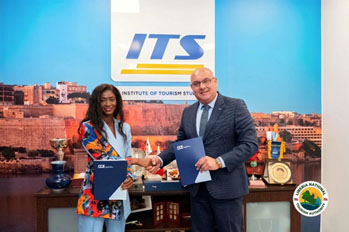
Liberia has recorded a major breakthrough in its effort to reposition tourism as a driver of economic growth, following a high-level four-day mission to Malta by the Director General of the Liberia National Tourism Authority (LNTA), Hon. Princess Eva Cooper.
The visit, anchored in a series of strategic Memoranda of Understanding (MOUs), signals a decisive shift from policy ambition to practical implementation, with clear gains in skills development, private sector expansion, institutional strengthening, and international market access. Malta, a European Union destination with a population of approximately 520,000, has emerged as one of Europe’s leading tourism success stories, attracting over 4.5 million visitors annually and generating between €3–5 billion in revenue—contributing nearly 20 percent to its GDP. Liberia’s engagement with such a model reflects a deliberate strategy to adopt tested systems capable of translating tourism assets into jobs and revenue.
During her official visit to Malta, the Director General of the Liberia National Tourism Authority, Princess Eva Cooper, held high-level engagements with a broad cross-section of public and private sector leaders, including Mr. Carlo Micallef, CEO of the Malta Tourism Authority, Pierre Fenech, CEO of the Institute of Tourism Studies, Joseph Galea of the Malta Chamber of Commerce, Enterprise and Industry; Philip Fenech of the Malta Chamber of SMEs; Kevin Callus of AX Hotels; Karl Farrugia Whismayer of DELAWS Group and FELTOM; Neal Debono and Ms. Valentina Mizzi of ME by Meliá Malta; Dario Guljelmovic of Special Interest Travel Ltd.; Andrew Aguis Muscat of the Malta Hotels and Restaurants Association; as well as representatives from Easy School of Languages, Easy Job Bridge, City Explorer Malta, Uniplural Academy, San Andrea School, and other key tourism, hospitality, education, and digital innovation institutions, reflecting a comprehensive engagement across Malta’s tourism ecosystem. Direct Pipeline to Jobs and Skills Development At the center of the mission is a landmark five-year partnership with the Institute of Tourism Studies (ITS) in Malta, which establishes structured pathways for Liberian youth to access international training, internships, and employment opportunities within Europe’s tourism sector.
Under the agreement, Liberian students will benefit from exchange programs, practical training, mentorship, and career placement support within Malta’s hospitality industry.
The arrangement goes beyond academic cooperation, introducing a full skills-to-employment pipeline that integrates classroom learning with real-time industry experience. It also includes curriculum development support, faculty exchange, and the exploration of scholarship opportunities, positioning Liberia to rapidly close its tourism skills gap.
In a reciprocal component, Malta is expected to deploy technical experts to Liberia to support training institutions and strengthen local capacity, while discussions are advancing toward establishing a satellite tourism training presence in Liberia.
Institutional Strengthening and Sector Reform
Beyond human capital, LNTA’s engagement with the Malta Tourism Authority (MTA) establishes a broad framework for institutional collaboration aimed at strengthening governance, policy development, and sector regulation.
The cooperation covers key areas including tourism policy, destination management, quality assurance, digital transformation, and sustainable tourism development. It also introduces mechanisms for joint marketing, participation in international platforms, and alignment with global standards in service delivery and certification.
This positions Liberia to transition from an informal tourism system to a structured, standards-driven industry capable of competing regionally and internationally.
Private Sector Expansion and Investment Opportunities
A significant outcome of the mission is the expansion of private sector linkages through agreements with the Malta Chamber of Commerce, Enterprise and Industry, and the Malta Chamber of SMEs.
These partnerships create direct channels for Liberian businesses—particularly small and medium-sized enterprises—to access European markets, build partnerships, and attract investment into tourism infrastructure and services.
The agreements highlighted business-to-business collaboration, joint ventures, and enterprise development, with targeted support for tourism operators, creative, and service providers.
They also introduce capacity-building programs focused on marketing, digitalization, and service excellence, aimed at improving competitiveness within the global tourism market.
From Exposure to Execution The outcomes of the Malta mission collectively signal a new direction for Liberia’s tourism sector one that prioritizes measurable results over symbolic engagement.
For the first time, Liberia has secured a multi-layered international framework that simultaneously addresses workforce development, institutional reform, and private sector growth. The integration of education, investment, and policy cooperation creates a comprehensive ecosystem for sector transformation.
According to dispatches from the mission, the partnerships are designed to be implementation-driven, supported by technical working groups, structured programs, and continuous engagement between the parties.
National Impact
The implications for Liberia are significant. Improved skills and service standards are expected to enhance visitor experience, while increased private sector participation and international exposure are likely to stimulate investment and job creation.
At a macro level, the initiative aligns with broader national objectives to diversify the economy, strengthen human capital, and position tourism as a viable pillar of growth.
As Liberia deepens its global engagement, the Malta mission seems to stand as a defining moment demonstrating how strategic partnerships can move the sector from potential to performance, and from aspiration to sustained economic contribution.