By Fiona Benson Kollie and Godgift Harris
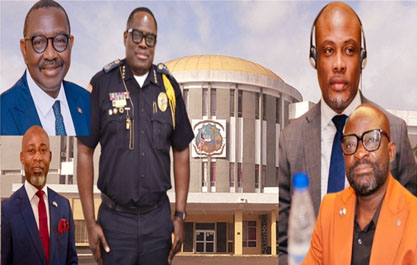
Pres, Boakai’s Press Secretary, Kula Fofana’s remark concerning the saga, has fueled public suspicion that the Executive Mansion may be tacitly endorsing a group unknown to, and unrecognized by state security authorities.
The recent report of a group calling itself, National Fula Security of Liberia, with the acronym (NFSL), has claimed lawmakers’ attention.
The situation has meanwhile, prompted the leadership of the House of Representatives (HoR) to invite the Minister of Justice, National Security Agency (NSA), Director, and the Inspector General (IG) of the Liberia National Police (LNP) to appear before leadership on Monday, February 22, to provide clarity on reports concerning the formation of such a group in the country.
The House’s decision followed separate communications from Representatives Taa Wongbe and Luther Collins.
The pair communications drew Plenary attention to the information circulating in both traditional and social media regarding the formation and training of the group.
The reports suggest that the group is intended as a community-based protection structure, but unconfirmed reports have emerged of more recruitment in other parts of the country.
Some of the lawmakers said, while some public statements have portrayed the initiative as lawful, serious questions remain regarding its “naming, branding, organizational structure, training activities, and whether such actions were duly authorized under the laws.”
They also said, given Liberia’s history, matters of national security require “absolute clarity.” The lawmakers noted that the constitution vests responsibility for national security solely in legally established state institutions, and any structure perceived as parallel or ethnically branded demands immediate scrutiny to safeguard public confidence and national cohesion.
In view of these concerns, the House leadership has requested the Ministry of Justice, the Liberia National Police, and the National Security Agency to appear before Plenary to clarify the legal status, authorization, and scope of the reported group.
The institutions are also expected to inform the House of any actions taken to preserve public confidence and maintain national peace and security.
The House reaffirmed its commitment to uphold constitutional order, national unity, and effective oversight of security-related matters in the interest of all.
Presidential Press Secretary
In a related development, President Joseph Nyuma Boakai Press Secretary has issued remarks on National Fula Security, drawing fresh controversy.
The controversy followed Kula Fofana’s remark in which she appeared to defend the activities of National Fula Security of Liberia.
Although Madam Fofana has insisted that her comments were made in a personal capacity, critics argue that her position as the Boakai’s chief spokesperson inevitably blurs the line between personal opinion and official government posture.
The remark has fueled public suspicion that the Executive Mansion may be tacitly endorsing a group unknown to, and unrecognized by state security authorities.
This perception is sharply at odds with official statements from the Ministry of Justice and the Liberia National Police, both of which have publicly stated they have no knowledge of, or formal relationship with, the so-called National Fula Security.
The contradiction has intensified concerns about policy coherence, command responsibility, and government’s handling of “sensitive security matters.”
Personal view or presidential signal?
In a detailed statement circulated amid mounting criticism, Madam Fofana, who identifies as an active member of Liberia’s Muslim community, rejected allegations that she supports any armed or paramilitary formation.
“I opposed any military or paramilitary organization whose purpose is to cause violence, intimidation, or destabilization.”
Madam Fofana also underscored the primacy of peace, national unity and the rule of law.
Yet many Liberians remain unconvinced as analysts argue that when a senior presidential aide publicly contextualizes and appears to legitimize a controversial group, the message resonates far beyond personal belief.
“When you speak from the office of the presidency, there is no purely private lane. Every word carries institutional weight,” one civil society actor told this newspaper.
The debate was sparked by a viral video showing uniformed men identifying themselves as members of the National Fula Security.
The imagery uniforms, formation, and apparent coordination immediately raised red flags in a country still shaped by the memory of armed groups and civil conflict.
In her defense, Madam Fofana argued that the organization has existed quietly for years within the Muslim community, operating primarily during major Islamic events such as Ramadan prayers, Eid celebrations, and visits by international clerics.
She cited crowd-control roles during large gatherings, including visits by Islamic scholars like Mufti Menk, where she claimed the group coordinated informally with police to prevent injuries and disorder.
However, critics counter that anecdotal assurances do not substitute for legal recognition or statutory oversight. Security framework, they argue, does not permit parallel or informal security structures no matter how benign their stated intentions to operate without clear authorization and regulation.
At the heart of the controversy is not only what the group does, but how it is perceived, and how the government responds.
Security experts warn that allowing unregistered groups to present themselves as “security” entities risks setting a dangerous precedent, particularly in a fragile post-conflict society.
While comparisons have been drawn to volunteer ushers and marshals at large Christian gatherings, observers note a key difference, church volunteers do not typically brand themselves with names implying national or ethnic security authority.
The term “National Fula Security,” critics say, carries ethnic and coercive overtones that amplify fear and mistrust; drawing experience from some predominately sub-regional Muslim environments.
The unfolding saga has prompted renewed calls for the government to speak with one voice.
Transparency advocates argue that MoJ and law enforcement agencies must clearly outline whether such groups are lawful, how community volunteerism should be structured, and where the red lines lie.
More pointedly, some commentators say the Executive Mansion must clarify whether Madam Fofana’s remark reflects official policy or personal conviction.
In the absence of such clarity, speculation will continue to fill the vacuum undermining public confidence in the administration’s commitment to security sector governance.
As Liberia navigates the heightened sensitivities of Ramadan and large public gatherings, the controversy underscores a broader challenge, balancing community participation in public safety with strict adherence to the rule of law.
For many Liberians, the pressing question is no longer whether the National Fula Security meant harm, but whether the state can afford ambiguity when it comes to who is authorized to provide security and under what authority.