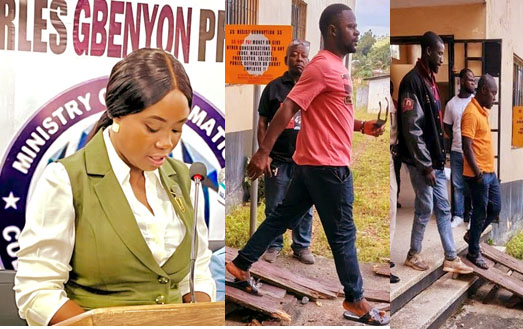
Two high profiled individuals, including the Lofa County Community (LCC) president and Gbarpolu County Superintendent are being accused of “massive corruption.”
The Liberia Anti-Corruption Commission (LACC), has updated the public at latest cases forwarded to court.
The Commission meanwhile, wishes to inform the public of recent legal developments arising from ongoing corruption cases under prosecution.
On Monday, November 17, 2025, the LACC filed a Motion for Change of Venue in the case involving the President of LCC, Dr. Isaac P. Podah.
The case, according to the Commission, concerns allegations of financial irregularities and misuse of institutional resources.
After arguments were presented, the motion was denied on Friday, November 21, 2025, by His Honor Judge Paye Suah, Presiding Judge of the 10th Judicial Circuit, Lofa County, who ordered that the case proceed in the county.
The Commission request for a change of venue was based on the continued control of the Institution by defendant
Podah.
He remains in full authority over the college, as no executive action has been taken to remove or suspend him since the indictment.
The Commission believes that his ongoing leadership role poses a risk of direct or indirect influence over staff, students, and potential witnesses connected to the trial.
Dr. Podah service at LCC as being viewed as a “Potential Jury Bias” due to local ties.
A jury assembled within the county is highly likely to include students, former students, or individuals, who may be professionally or socially connected to Dr. Podah.
The Commission maintains that such community ties could create an atmosphere of prejudice, compromise neutrality, and hinder the fair administration of justice.
The Lofa Community College matter, is one of two venue-change motions filed by the LACC this month.
The second Case
The second case involves the Gbarpolu County “Yellow Machine,” in which the defendant is Superintendent Sam K. Zinnah.
In that case, the Commission similarly petitioned for a change of venue, noting that Supt. Zinnah’s executive authority poses a risk of juror intimidation, influence, or perceived obligation that may undermine the impartiality of the proceedings.
Across both cases, the Commission reiterates that its actions are guided by a singular objective: to ensure that justice is delivered without fear, favor, or undue influence.
The LACC said, it remains steadfast in its mandate to protect the integrity of the judicial process, uphold transparency, and guarantee that corruption cases are adjudicated in environments free from political weight or local pressures.
The LACC meanwhile, assures the public that it will continue to pursue all legal remedies available, while working collaboratively with the courts to ensure fair and credible outcomes.