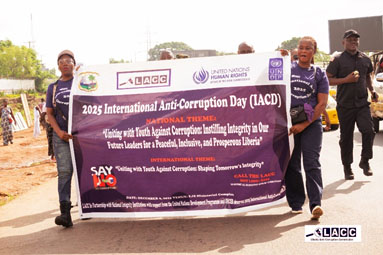
Liberia Anti-Corruption Commission (LACC) on Tuesday, December 9, 2025, joined other countries around the world in commemorating this year’s International Anti-Corruption Day (IACD).
The event was hosted under the national theme: “Uniting with Youth Against Corruption for a Peaceful, Inclusive, and Prosperous Liberia.”
The International theme for this year: “Uniting with Youth Against Corruption: Shaping Tomorrow’s Integrity.”
The event is a global observance dedicated to strengthen integrity, promotes accountability and mobilizes collective action against corruption.
The significance of the Day is rooted in the history of the United Nations Convention Against Corruption (UNCAC).
LACC Commissioner for Monitoring and Investigation Department, Dr. Miatta Jah, said the UNCAC was adopted by the United Nations General Assembly (UNGA) in October 2003, marking the first, and only globally binding legal instrument dedicated solely to combat corruption in all its forms, prevention, investigation, prosecution, asset recovery, and international cooperation.
Dr. Jah said the convention entered into force on December 14, 2005, after securing the required number of ratifications.
“Today, UNCAC has near-universal ratification with over 190 state parties, including Liberia, which ratified the Convention in 2005.”
Dr. Jah continues: “Its implementation is monitored through a peer-review mechanism that assesses national transparency, accountability, enforcement and preventive frameworks.”
She said, Liberia’s assurance to the landmark Convention continues to demonstrate its commitment through legislative reforms, institutional strengthening and public education.
In his Anti-Corruption Day Message Tuesday, December 9, 2025 in Monrovia, LACC Acting Executive Chairperson, Attorney Samuel F. Dakana, said corruption continues to stand as one of the greatest threats to peace, and national stability, as it weakens institutions, deprives citizens of basic services, fuels inequality and undermines trust in public leadership.
Dakana said if left unchecked, corruption can reverse the gains the country has made over the years, as a peaceful and inclusive country requires a governance system anchored in transparency.
He said a prosperous Liberia requires that public resources benefit all Liberians, and not a selected few, and that is why the LACC is intensifying effort in prevention, investigation, prosecution support, enforcement of asset declaration, system reform and public engagement.
“Over the past years, the LACC has taken concrete actions to strengthen Liberia’s integrity system, that include improving investigative capacity and advancing corruption cases; expanding awareness and community outreach, as well as enhancing the digitization of the Asset Declaration and verification regime. The Commission also strengthened partnerships with other institutions, promotes early warning systems through community informants and whistle-blower engagement.”
Atty. Dakana indicated that said efforts are intended not just to punish corruption, but to prevent it, build a culture of honesty and responsibility across all sector.
On this year’s theme, he said the program is not only timely, but it is urgent, strategic and deeply relevant to the future of the country, as the young people are the heartbeat of transformation.
Dakana defines corruption as a system that steals from the national budget; it is the young people who lose access to quality education, healthcare, jobs, roads and opportunities. As such, the fight against corruption cannot be won without the active leadership and participation of the youth.
He then officially launched the institution’s Anti-Corruption textbook, hotline and whistleblower box.
“Today, we join the global community in commemorating a share International responsibility to fight corruption, and renew country’s commitment to build a society governed by integrity, accountability and equal opportunity.”
Young Political Leadership of Africa Youth Development Practitioner, Ms. Alphia Faith Kemokai, served as the guest speaker for the program.
Ms. Kemokai cautioned her colleagues against any act that would lead them to practice corruption, because it has shaped the past, and its impact is visible in the educational, health, and even at places of worship.
She strongly believes that if government work closely with the young people, by supporting their leadership, and strengthen its national commitment, the country can rise above corruption, and build a peaceful, inclusive and prosperous nation, one that the next generation will be proud of.
Some of the development partners at the program, commended the LACC for the fight against corruption, as its slowdown economic growth, and development, thereby hampering the development of the young people.
Macpherson C. Marbiah writes/0886442882-0777250370