By Julius Konton
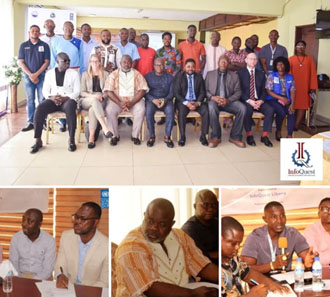
Liberia has recorded a significant milestone in its long-running decentralization journey with the official transition of the Ministry of Internal Affairs (MIA) into the newly established Ministry of Local Government.
This move civil society leaders described as a turning point in democratic governance and service delivery.
InfoQuest Liberia Executive Director, Matthias Yeanay, said the transition represents a decisive step in implementing the Local Government Act of 2018.
The Act is a reform law designed to devolve political, administrative, and fiscal authority from the central government to local authorities.
“This transition is far more than a change of institutional name or structure. It signals a renewed national commitment to people-centered governance, equitable resource distribution, improved service delivery, and the strengthening of local authorities,” Yeanay told journalists. “
The decentralization agenda dates back to the post-conflict reconstruction era, when governance reforms were identified as critical to stabilize the country after 14-long years of civil war.
Despite steady economic growth in parts of the last decade, decision-making and fiscal power remained largely centralized, limiting development outcomes in rural and peri-urban communities where more than 70 percent of population resides, according to national demographic estimates.
The 2018 Local Government Act was enacted to reverse the imbalance by granting counties, districts, cities, and chiefdoms greater autonomy in planning, budgeting, and development execution.
However, implementation delays particularly around institutional realignment and revenue-sharing mechanisms slowed progress for several years.
The formal transition to a Ministry of Local Government is now seen as a critical institutional anchor for accelerating those reforms.
Yeanay said the milestone stands as one of the achievements InfoQuest Liberia is deeply proud of, reflecting years of sustained advocacy and policy engagement.
“InfoQuest remains steadfast in its mission to support reforms that empower communities and strengthen accountable governance. We are committed to ensuring an inclusive and informed society where citizens understand and participate meaningfully in governance.”
Yeanay stated that through sustained advocacy, policy dialogues, and stakeholders’ mobilization, supported by UNDP Liberia, InfoQuest played a leading role in pushing legislative and regulatory frameworks forward.
According to him, the efforts focused particularly on decentralization and revenue-sharing, which are widely viewed as essential to reduce inequality and strengthening local development.