By Godgift Harris
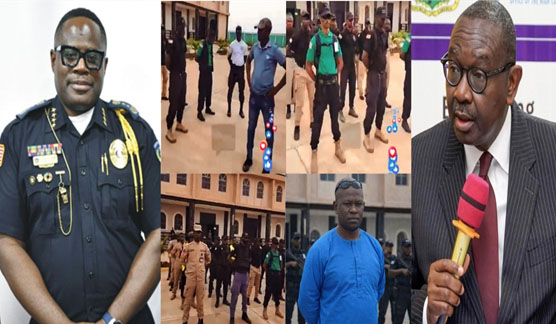
Though government has distanced itself from claim by the self-style National Fula Security, reports had emerged of continuous recruitments at various locations.
The Liberia National Police (LNP), has also distanced itself from a controversial video circulating widely on social media that shows a group of men in security-style uniforms identifying themselves as the “National Fula Security of Liberia (NFSL).”
While police authorities insist, they have no knowledge of, or relationship with the group; the episode has ignited intense public debate and revived long-standing fears about the emergence of unregulated security formations in a country still struggling to overcome the legacies of civil conflict.
In a brief public clarification, the LNP said, it has never held meetings with the group featured in the video and does not recognize its existence.
In the aftermath of the situation, there are unconfirmed reports that recruitment continues at various locations.
According to the police, the footage was first brought to their attention through social media rather than through any formal intelligence or security channel.
The LNP further disclosed that the Ministry of Justice (MoJ), through its Public Safety Division, has reviewed the matter, and that updated will be provided as discussions continue.
Although the statement was intended to calm public anxiety, critics argue it raises as many questions as it answers.
A painful history rekindled
For many Liberians, the sudden appearance of a self-styled security outfit, particularly one invoking an ethnic identity touches a raw nerve.
Liberia’s civil war history is marked by factional militias, child soldiers, and community-based armed groups that often began as so-called self-defense units before evolving into instruments of violence and coercion.
The video, which circulated earlier this week, shows dozens of men standing in formation; some wearing uniforms resembling those of formal security agencies.
They identify themselves as members of the “National Fula Security of Liberia” and appear to suggest a mandate centered on community protection.
Although no weapons are visible, the imagery of uniforms, organization and ethnic branding has unsettled a public keenly aware of how quickly symbolism can translate into real-world violence.
“This country has paid too high a price to allow any group to organize itself as a parallel security force,” said a civil society activist.
“Even if their intentions are peaceful, the symbolism alone is dangerous.”
The LNP’s claim that it had no prior knowledge of the group has been met with skepticism in some quarters.
Critics question how a group large enough to organize uniforms, coordinate messaging, and circulate a nationally viewed video could emerge without drawing the attention of local police commanders or intelligence services.
Security analysts say the clarification underscores potential weaknesses in early-warning and intelligence-gathering mechanisms.
“The issue is not only whether the LNP recognizes the group,” a regional security expert noted.
“It is whether the state has the capacity to detect, monitor and prevent the emergence of unauthorized security actors before they become a threat.”
The use of the term “Fula” in the group’s name has further complicated the situation. The Fula, or Fulani community, spans several West African countries, and has often faced discrimination and stereotyping in the region.
In Liberia, ethnic identity has historically been exploited during periods of instability.
Community leaders warn that associating security with a single ethnic group risks deepening mistrust and fueling resentment among other communities.
There are also fears that ordinary Fula residents; many of whom have no connection to the group could face backlash or suspicion as a result.
“This is not just about one video,” said a human rights advocate, but about the dangerous precedent of ethnic branding in security matters.”
That is how divisions are created and conflicts are born with conflicting narratives emerging amid the controversy, a Fula community leader has issued a statement suggesting that the group’s intent is to protect “Fula property and places of worship, specifically during the months of Ramadan.”
According to the statement, the initiative is meant to prevent theft of motorcycles and tricycles (kekes) around mosques, while worshippers are inside for prayers, not to function as an armed or national security force.
However, many Liberians remain unconvinced.
Critics argue that even if the intentions are limited, the adoption of uniforms and the label “national security” crosses a dangerous line in a post-conflict society where the monopoly of force is constitutionally vested in the state.
Beyond the police clarification, the broader government response has been muted.
Apart from noting that the MoJ is reviewing the issue, authorities have provided no timeline, details of the investigation’s scope, or clarification of the group’s legal status.
Opposition figures and civil society organizations are demanding greater transparency, arguing: What does the Fula want?”
They want clear answers to whether the formation of such a group violates existing laws, whether those involved will be summoned or questioned, and how the government plans to prevent similar developments.
Liberian law is explicit that only the state may provide national security, and that any private security operation must be licensed, regulated, and non-militarized.
A group presenting itself as a “national” security body, critics argue, potentially crosses legal and constitutional boundaries.
Public Fear and Fragile Trust
Public reaction has been swift and emotional.
Radio talk shows and online forums, have been flooded with calls expressing fear that the country could be sliding toward a familiar and painful path.
Many recalled how armed groups during the civil war often began as community defenders before morphing into predatory militias.