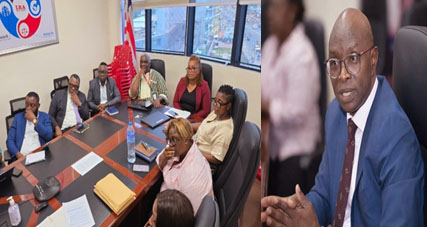
International Monetary Fund (IMF) Resident Representative to Liberia, Joel Chiedu Okwuokei, on Tuesday, February 17, 2026, presented a broad range of specialized training and capacity building opportunities to the Liberia Revenue Authority (LRA).
The initiative, according to a release, represents a significant step toward strengthening institutional performance and advancing domestic resource mobilization agenda.
Mr. Okwuokei made the disclosure during a meeting with Commissioner General James Dorbor Jallah, and members of the Authority’s senior management team at the LRA headquarters in Paynesville, outside Monrovia.
Okwuokei formally introduced the Keynes Lab, a newly established high-tech training facility at the IMF office in Liberia, and encouraged LRA officials and staff to take full advantage of the learning opportunities available.
The Keynes Lab features modern IT infrastructure, high-speed internet connectivity, ergonomic workstations, and advanced econometric software designed to support rigorous policy-oriented and technical training.
Mr. Okwuokei said, enhancing institutional capacity is essential to meet evolving global standards in revenue administration, and macroeconomic management.
He said, the LRA plays a critical role in national development trajectory, and that sustained professional development, is fundamental to improve operational efficiency and strategic impact.
The training programs cover a broad spectrum of macro-fiscal and policy-relevant disciplines, including macroeconomics, fiscal policy, monetary policy, exchange rate policy, public finance management, financial sector policies, macro-criticality of climate change, inclusive growth, and digital transformation.
These thematic areas are directly aligned with strengthening revenue performance, policy analysis, and evidence-based decision-making within the LRA.
Mr. Jallah welcomed the initiative, which he described as a “transformative opportunity for the Authority.”
He expressed gratitude to the IMF for extending access to the training programs, noting that the initiative will significantly enhance the LRA’s institutional capacity and contribute to Domestic Resource Mobilization strategy.
“This is a very significant opportunity for the LRA. We have consistently invested in capacity building to improve performance and service delivery, and we will take full advantage of this offer. We encourage our staff to expand their knowledge and strengthen their professional competencies.”
Mr. Jallah further urged heads of departments and units, as well as the Human Resource Management Division, to coordinate effectively to ensure that staff fully utilize the training opportunities without disrupting core operations.
He spoke of the importance of structured participation schedules that safeguard continuity in daily assignments and sustain the Authority’s revenue collection performance while staff members engage in professional development.
Jallah also observed that the availability of in-country training through the IMF will substantially reduce associated costs while enabling staff to pursue sustained learning over time with minimal operational disruption. Savings realized from reduced training expenses, he noted, can be redirected to other priority areas within the Authority’s operations.
The expanded collaboration between the IMF and the LRA reflects a shared commitment to building resilient public institutions capable of driving fiscal sustainability and national development.