By Kolleh Morris
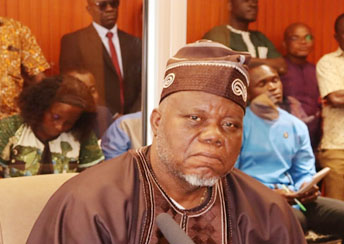
River Cess County Senator Bill Twehway (sanctioned), has introduced a monetary reform proposal in the Senate titled: “The Gold Reserve and Currency Stabilization Act of 2026.”
The bill seeks to partially anchor the Liberian dollar to domestically sourced gold reserves to control inflation; strengthen external reserves, and reinforce long-term macroeconomic stability.
The legislation proposes a structural shift in monetary framework by integrating gold reserves into the Central Bank of Liberia’s reserve management strategy. Twehway said, the measure aims to stabilize the Liberian dollar through asset-backed support; reduce inflationary pressures driven by currency depreciation; improve investor confidence and sovereign creditworthiness, and build resilience against external shocks.
Rather than relying predominantly on foreign currency reserves, the proposal positions domestically mined gold as a strategic monetary asset.
The bill, when enacted, mandates that CBL establish a National Gold Purchase Program.
Under this program, CBL would be granted the “Right of First Refusal” to purchase a defined percentage of all gold mined. This mechanism is designed to prevent excessive capital flight through raw gold exports and to retain strategic mineral wealth within national reserves.
Furthermore, medium-and large-scale mining companies would be required to remit a 1 percent royalty in physical gold, not cash.
This ensures the state directly accumulates bullion rather than relying solely on monetary payments that may depreciate.
Accumulated gold would serve as part of official reserve assets.
While not proposing a full gold standard, the bill supports partial reserve backing to enhance monetary credibility; reduce overreliance on the U.S. dollar, and cushion exchange-rate volatility.
The legislation provides for the establishment of a National Gold Refinery, supported by incentives for domestic value addition. Within 36 months of enactment, exporters of raw gold not refined to at least 95 percent purity would face a refining surcharge.
The objective is industrial upgrading moving from a raw mineral exporter to a value-added producer.
Also, the bill prescribes strict penalties for gold smuggling; falsification of production records, and undeclared exports.
Given persistent illicit mineral flows in West Africa, enforcement capacity will determine the bill’s credibility.
To prevent political interference or reserve mismanagement, the proposal establishes a Gold Reserve Oversight Committee composed of representatives from the Ministry of Finance and Development Planning, CBL, the Ministry of Mines and Energy, and the Chamber of Commerce.
The committee would publish quarterly reserve reports, improving transparency in reserve accumulation and currency impact. Sen. Twehway recommended that the Act would take effect immediately upon passage.
According to available data, gold reserves historically serve three macroeconomic purposes: it maintains intrinsic value and are not subject to arbitrary monetary expansion. When a central bank holds gold, it strengthens market perception that the currency is not purely fiat-based; Strong reserve assets reduce speculative attacks on weaker currencies. Markets view gold as a universal store of value. And in times of global crisis, gold often appreciates, offsetting foreign reserve losses. However, gold backing alone does not guarantee stability. It must be paired with disciplined fiscal policy, controlled deficit spending, and strong monetary governance.
Several countries demonstrate the strategic role of gold in reserve management: the Swiss National Bank maintains substantial gold reserves relative to its economy. Although Switzerland abandoned a strict gold standard decades ago, gold remains a credibility anchor for the Swiss franc. Russia significantly expanded its gold reserves after 2014 to reduce dependence on U.S. dollar assets. This diversification strengthened its ability to withstand sanctions and currency volatility.
Furthermore, China steadily accumulates gold to diversify foreign exchange reserves and support long-term maintenance of its credibility in global markets.
Ghana launched the “Gold for Oil” program to use domestically purchased gold in managing foreign exchange pressures. While not a full currency-backing model, it illustrates how mineral wealth can be leveraged for macroeconomic stabilization.
While the proposal is structurally ambitious, its success depends on: transparent reserve auditing, independent central bank governance, effective anti-smuggling enforcement, sustainable mining production levels, and careful calibration to avoid over-concentration in gold. Over-reliance on gold without parallel fiscal reform could create false confidence. Conversely, disciplined implementation could reposition Liberia’s monetary framework toward greater sovereignty and stability. If enacted and properly executed, the Gold Reserve and Currency Stabilization Act of 2026 could represent a decisive shift in Liberia’s macroeconomic strategy — transforming gold from an export commodity into a strategic monetary asset.