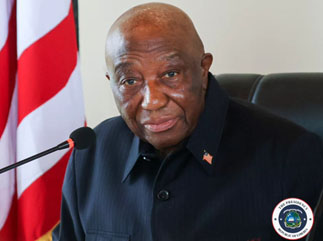
In a landmark development for public financial oversight in Liberia, the General Auditing Commission (GAC) has completed the first audit of the Office of the President in the institution’s history, a move widely viewed as a significant advance for transparency and accountability at the highest level of government.
The announcement was made Tuesday by Auditor General P. Garswa Jackson, Sr. during the launch of the GAC Strategic Plan 2026–2030. Jackson described the audit as a decisive break from past practice and a clear signal that no public institution is beyond scrutiny.
“This audit is historic. Never in the Commission’s history has the Office of the President been audited,” Jackson said, emphasizing that the exercise reflects the GAC’s commitment to applying the same financial oversight standards across all branches and offices of government.
Ending a Longstanding Exception
Although the GAC is constitutionally mandated to audit all public institutions that manage state resources, the Office of the President had traditionally remained outside the scope of routine audits. This exclusion was largely driven by political sensitivities and longstanding norms that treated the presidency as operationally autonomous.
According to the Commission, previous audits covered ministries, agencies, commissions, the Legislature, Judiciary, security institutions, and key economic entities such as the Central Bank of Liberia. The presidency, however, had not been subjected to a standalone post-war audit until now.
The audit is part of a broader expansion of GAC activity under Jackson’s tenure. Over the past three years, the Commission has conducted 258 audits—the highest number in its history—and published more than 224 audit reports spanning nearly all sectors of government.
Strengthening Liberia’s Audit Framework
Liberia’s modern audit regime was shaped by post-conflict reforms, particularly the 2005 legal amendments that strengthened the Auditor General’s independence and required direct reporting to the Legislature. These reforms were intended to insulate the GAC from political pressure and enhance its ability to enforce accountability.
In recent years, the Commission has released several high-impact reports, including audits exposing payroll irregularities and systemic non-compliance at the Ministry of State for Presidential Affairs across multiple administrations. Other audits have examined community forestry management, sector-specific compliance, and national financial practices, underscoring the GAC’s increasingly broad mandate.
Political Context and Public Expectations
The decision to audit the Office of the President coincides with the governance agenda of President Joseph Nyuma Boakai, who took office in January 2024 pledging to prioritize anti-corruption and fiscal discipline. His administration has supported audits of major institutions, including the Central Bank and security agencies, and promoted measures aimed at restoring public trust in government finances.
President Boakai has also taken symbolic steps—such as voluntary salary reductions and support for transparency initiatives—to reinforce that agenda. The presidency audit aligns with these signals and with commitments outlined in the GAC’s new Strategic Plan, which emphasizes consolidated audits, compliance reviews, and stronger follow-up mechanisms.
Accountability Beyond the Audit
Civil society groups and public finance experts argue that the true importance of the audit lies not only in its findings but in its symbolism: it establishes that even the presidency is subject to financial oversight under the law.
However, they caution that audits alone do not guarantee accountability. The effectiveness of the process will depend on whether audit recommendations are implemented, whether the Legislature enforces compliance, and whether violations—if identified—carry real consequences.
The GAC has indicated that additional reports and legislative hearings will follow, aimed at improving enforcement and ensuring that executive offices adhere to transparent financial practices.
As Liberia continues to confront the legacy of weak fiscal controls and public mistrust, the audit of the Office of the President marks a defining moment—one that could reset accountability norms for future administrations if followed by sustained action.