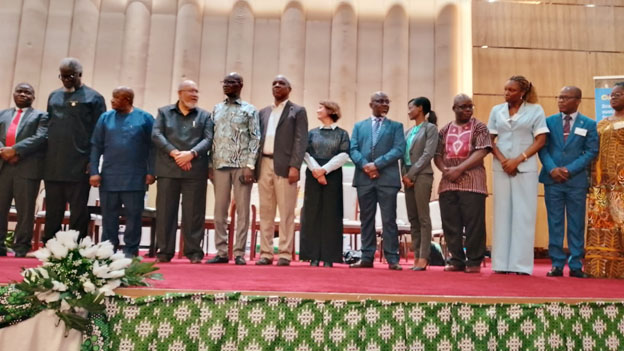
The Forestry Development Authority (FDA), and partners on Monday, November 3, officially commenced the 2025 National Forest Forum (NFF).
The forum will end today, Wednesday, November 5, 2025.
The exercise aims to enhance partnership, affirm commitments to a sustainable forest management.
The forum is being held under the theme: “Leveraging Liberia’s Forest for Economic, Social and Environmental Sustainability.” It focuses on people, planet and profit.
It is expected to serve as a platform that will highlight the institution’s accomplishments, challenges and lessons learned within the forest sector since the last forum was held in 2023.
It brought together delegates from the World Bank, African Development Bank, the United Kingdom Department for International Development (UKAID), Swedish International Development Cooperation Agency (SIDA), and representatives from government institutions.
The Senior Advisor to President Joseph Nyuma Boakai on Foreign Affairs, Dr. Augustine Konneh, delivered the opening statement on behalf of the President.
Konneh told the gathering that the National Forest Forum provides an important space for reflection, dialogue and collective commitment toward safeguarding the sustainable managing of country’s rich forest heritage.
Dr. Konneh noted that despite the enormous endowment, Liberia forest sector has not performed to its full potential since the end of the country civil conflict.
He said, forest institutions remain weak; enforcement of laws and regulations remains inconsistent, illegal activities, encroachment as the overlapping of land uses still persist.
“The potential of forest carbon, biodiversity, conservation and community forest management remains largely untapped,” Dr. Konneh.
Meanwhile, the President envision a robust, transparent and a well-functional forest sector; one that is accountable, efficient and responsive to both the needs of the citizens as well as the environmental obligations of the country.
In the 2004 National Forest Inventory conducted by the World Bank Group, and the FDA, the total forest cover was estimated at 4.3 million hectares.
On the contrary, “the country is be told that this figure has increased to 6.6 million hectares. This sudden increase of 2.3 million hectares raises serious question,” Konneh said.
The President has therefore mandated the FDA Senior Management along with its team of experts, to report to his office within one week; a clear explanation and reconciliation of the discrepancies surrounding Liberia’s total standing forest cover.
FDA Managing Director, Rudolph J. Merab, told the gathering that the country has failed to implement a proper reform in the forest sector over the last 19 years.
Merab said, there has been no improvement; something which has led to the forest been destroyed by illicit activities, and claims of individuals interests over and above the national interest.
He said Liberia’s forest revenues have collapsed from over US$40 million before the civil war to less than US$5 million in 2024; a projection of US$5 million in 2025, which is not just a decline, but a disaster, and disgrace that does not present the truth worth of the country forest, nor does it provide the needed revenue to adequately manage the sector.
“A sector once contributing 10 percent of the GDP now barely scratches the surface. Before the war, Liberia’s forests were the pride of West Africa. The world came to us for timber, our rural people had jobs, and our nation saw growth. Then the wars came, the sanctions and finally the collapsed of the sector. Our forests were plundered, misused and disgraced,” Mr. Merab recalled.
He said most commercial enterprises have failed, as tens of thousands cubic meters of logs have been harvested, and abandoned all over the country with no benefits to communities or the government.
Earlier in his welcome statement, FDA Deputy Managing Director for Administration and Finance, Victor W. Kpaiseh, noted that the country beautiful forest canopy serves as the lifeblood of the ecosystems, supporting biodiversity and playing a critical role in combating climate change.
“What we have is not just a forest with beautiful trees, but a home of countless species, and a buffer against the devastating impacts of climate change. What remains unhandled is the use of these forests for the provision of invaluable resources to fully address the livelihood of the millions of people that depend on it,” Mr. Kpaiseh said.