By Abraham K. Morris, Contributor
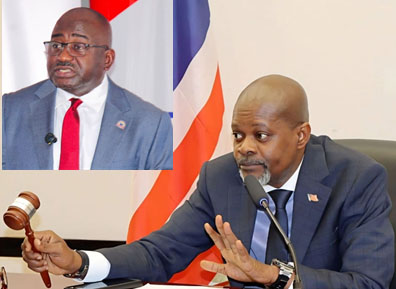
Montserrado County Senator Abraham Darius Dillon has sharply refuted Nimba County D7 Representative Musa Hassan Bility accusation against the senate.
Bility has recently described the senate being in “constitutional error” for conducting its own national budget hearings.
Dillon described the claim as legally flimsy, historically uninformed, and dangerously misleading.
Rep. Bility, in a formal communication to House Speaker Richard Nagbe Koon, demanded that the senate immediately halt its hearings.
He argued that the House alone is empowered to originate the national budget. Bility said any early engagement by the senate threatens constitutional order, and risks institutional chaos.
But in reaction, Dillon said such argument collapses under even basic constitutional scrutiny.
He noted that the House originates budget, but the senate has full review power.
In a point-by-point rebuttal, Dillon acknowledged that the constitution assigned the House the duty to originate fiscal legislation.
However, he said “origination” does not equal “exclusive control” over the budget process.
He underscored the need for the Senate to hold full concurrence authority; allowing it to review, amend, or revise the budget after House passage.
Senate hearings, he said, are part of responsibly preparing for that concurrence role.
“The only constitutional restriction is that the Senate cannot pass the budget before the House acts.”
Dillon added: “Nothing absolutely nothing, in the constitution bars the Senate from holding hearings. Hearings are not originating legislation.”
Dillon noted that if the Senate introduces amendments that differ from the House’s version, the process requires a conference committee to reconcile the two drafts into a final budget for the Executive Branch.
He said the dual-track hearing structure has been the legislature’s standard practice for decades.
However, Rep. Bility warned of ‘institutional conflict.’
His letter paints a far more dire picture, which raised three primary concerns: that the Senate hearings amount to usurping the House’s origination authority; violating Article 34(d)(i) of the 1986 Constitution; that the hearings are premature, because the House has not finalized its review of the submitted draft budget, and that such parallel action invites institutional conflict and public confusion.
On these grounds, Bility requested that the House formally instruct the Senate to suspend its hearings until the House completes its initial constitutional review.
Meanwhile, the House is expected to review Bility’s complaint, but it is now expected to evaluate the arguments, a review that could impact both the tempo and structure of the 2025 budget cycle.
Any escalation between the chamber’s risks delaying the passage of the National Budget; a document both bodies agree is central to governance and the delivery of essential public services.
As the legislature moves deeper into budget season, the clash highlights a recurring fault line in the governance; the ongoing struggle to balance constitutional interpretation with institutional boundaries. Whether this latest dispute becomes a temporary wrinkle or a full-blown standoff, will depend on how both chambers navigate the weeks ahead.