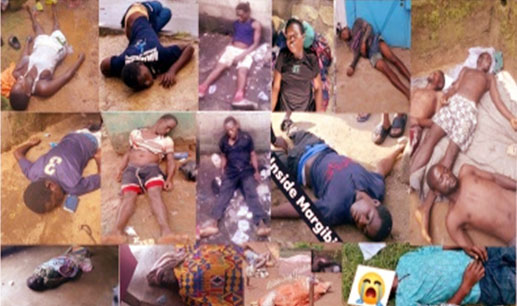
Those new substance-abuse or drugs are being identified as Kush, Jakaban Kush, Sparkling Android and Metralindole.
Among those illicit drugs, only Sparkling Android is being sold by its street name: ‘Spark.’ This spark is sold in smaller pre-parked parcel value at L$100.
The newly discovered illicit drugs on the local market are now killing many of its users, manly the young ones.
The illicit substances have already been identified as Sparkling Android, or commonly known to the users as ‘Spark.’
The spark, when consumed, its users suddenly become prey unless, he/she is revived by another person versed in the ‘take-in’ process.
Anything short of the needed assistance, the users would fall and died.
In just a week, it is reported that four persons died in the Soul Clinic Community, while several others, excluding Zogos, and their newly recruits, have been found dead in several other locations.
On this, the public is of the opinion that, “dey tin is really killin our men dem plenty,” because, in the wake of the prevailing tragedies, some new recruits have challenged the ‘taste of the Spark,’ and have reportedly died.
Meanwhile, authorities at the Liberia Drugs Enforcement Agency (LDEA) said, it is recommitted to the “Say No To Drugs” Campaign.
While the August 7 campaign characterized by solidarity marches across the country seems to be producing some positive results, there are contrary reports of the proliferation of the illegal substances.
In view of the “Say No To Drugs” LDEA, has continued to reaffirm its unwavering support to the national initiative.
The campaign represents a renewed national effort to combat the escalating challenges of drug abuse and trafficking in the country, but of recent, it is instead killing the abusers.
The Say No To Drugs exercise aims to raise public awareness, foster community responsibility, and mobilize collective action.
This solidarity march was more than a symbolic act, but a call to action.
Kush: what is this dangerous new west African drug that supposedly contains human bones?
A new drug called Kush is wreaking havoc in west Africa, particularly in Liberia and Sierra Leone where it is estimated to kill around a dozen people each week and hospitalized thousands.
The drug, taken mostly by men aged 18 to 25, causes people to fall asleep while walking, to fall over, to bang their heads against hard surfaces and to walk into moving traffic.
Kush should not be confused with the drug of the same name found in the U.S., which is a mixture of “an ever-changing host of chemicals” sprayed on plant matter and smoked.
Kush in Liberia and Sierra Leone is quite different; it is a mixture of cannabis, fentanyl, tramadol, formaldehyde, and according to some, ground down humans’ bones.
It is mixed by local criminal gangs, but the constituent drugs have international sources, facilitated no doubt by the internet and digital communications.
While cannabis is widely grown in Liberia and Sierra Leone, the fentanyl is thought to originate in clandestine laboratories in China where the drug is manufactured illegally and shipped to west Africa. Tramadol has a similar source, namely: illegal laboratories across Asia. Formaldehyde, which can cause hallucinations, (vision impairment, delusions) is also reported in this mixture.
As for ground human bones, there is no definitive answer about whether or not they occur in the drug, where such bones would come from, or why they might be incorporated into the drug. Some people say that ‘grave robbers’ provide the bones, but there is no direct evidence of this.
But why would bones be incorporated into the drug? Some suggest that the Sulphur content of the bones causes the users to get high.
Another reason might be the drug content of the bones themselves, if the deceased was a fentanyl or tramadol user.
However, both are unlikely. Sulphur levels in bones are not high. Smoking Sulphur would result in highly toxic Sulphur dioxide being produced and inhaled. Any drug content in bones in orders of magnitude less than that required to cause a physiological effect.
Where is the drug found?
The drug is reported in both Guinea and Liberia, which share porous land borders with Sierra Leone, making drug trafficking easy.
Kush costs around five Leones (20UK pence) per joint, which may be used by two or three people, with up to 40 joints being consumed in a day. This represents a massive spend on drugs and illustrates the addictive nature of the mixture, in a country where the annual income per capita is around £500.
The effects of the drug vary and depend on the user and the drug content. Cannabis causes a wide variety of effects, which include euphoria, relaxation and an altered state of consciousness.
Fentanyl, an extremely potent opioid, produces euphoria and confusion and causes sleepiness among a wide range of other side-effects. Similarly, tramadol, which is also an opioid, but less potent than fentanyl (100mg tramadol has the same effect as 10mg morphine) results in users becoming sleepy and “spaced out” – disconnected from things happening around them.
The Danger
The danger of the drug is two-fold: the risk of self-injury to the drug taker and the highly addictive nature of the drug itself.
A further problem is the need to finance the next dose, often achieved through “prostitution or criminal activity.”
Joining the ranks of existing poly-drugs
Kush is another example of polydrug mixtures of which forensic scientists are becoming increasingly aware. Another tobacco and cannabis-based drug, nyaope, otherwise known as whoonga, is found in South Africa. This time the tobacco and cannabis are mixed with heroin and antiretroviral drugs used to treat Aids, some of which are hallucinogenic.
A further polydrug, “white pipe,” a mixture of methaqualone (Mandrax), cannabis and tobacco, is smoked in southern Africa. These drugs are inexpensive and provide an escape from unemployment, the drudgery of poverty, sexual and physical abuse, and the effect, in some cases, especially in west Africa, from having been a child soldier.
So, what can be done about these drugs?
The effectiveness of legislation alone is questionable, and many of those who attend the very limited ‘rehabilitation centers’ return to drug use.
Perhaps what is required is an integrated forensic healthcare system where legislative control is backed up by properly resourced rehabilitation centers coupled with a public health and employment program. What changes are made in response to this epidemic remains to be seen.
Methadone
Methadone is a medicine used to treat heroin dependence. It is taken daily to relieve heroin withdrawal symptoms and reduce cravings for heroin.
The aim of methadone maintenance treatment is to help you reduce your illicit drug use, but in the country, every illegal substance is being abused.
https://shorturl.fm/uJvlT
https://shorturl.fm/sNTYW
https://shorturl.fm/bHumy
https://shorturl.fm/y7JnT
https://shorturl.fm/wPagG
Kebap tasting tour Comfortable pace, not tiring at all. http://blogginmamas.com/?p=19464