By: Godgift Harris
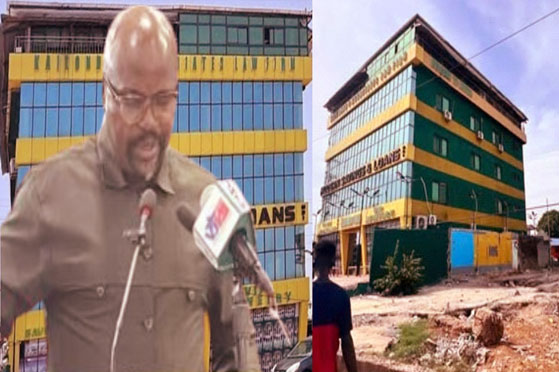
A storm of public criticism is mounting against Liberia’s Ministry of Public Works following controversial remarks by Minister Roland Layfette Giddings, whose defense of a privately- owned structure at the 5:40 Junction has ignited a nationwide debate over what many have described as selective justice and unequal enforcement of demolition policies.
At the center of the controversy is a building owned by George Kialondo, which Minister Giddings recently declared to be “safely positioned” away from the main road and therefore not subject to demolition.
The statement, delivered during a regular press briefing at the Ministry of Information, was intended to clarify the government’s ongoing demolition campaign targeting structures encroaching on public spaces.
In recent months, the Ministry of Public Works has intensified efforts to remove structures deemed to be illegally occupying roadways, alleyways, and drainage systems across Monrovia.
Authorities have argued that the exercise is necessary to address urban congestion, restore order, and mitigate persistent flooding.
But for many residents, the demolitions have come at a steep cost.
Entire communities have been displaced, with homes, shops, and informal businesses bulldozed often, residents claim, with little warning or opportunity to appeal.
The campaign has left scores of families homeless and stripped many small-scale traders of their livelihoods.
Against this backdrop, Minister Giddings’ decision to exempt the Kialondo building has raised serious questions about consistency and fairness.
“One Law for Some, Another for Others” critics argue that the government’s justification for sparing the Kialondo structure does not align with its treatment of other properties in the same area.
Eyewitnesses have reported that several buildings located along the same stretch at the 5:40 Junction were either partially or completely demolished during recent operations.
This perceived contradiction has intensified public skepticism.
“For the government to demolish homes belonging to struggling Liberians and then defend another structure in the same vicinity raises serious concerns,” one resident said.
“Is the law only for the poor?”
such sentiments are increasingly echoed by civil society organizations and community leaders, who warn that inconsistent enforcement risks eroding trust in public institutions.
Human Cost Overshadowed
Beyond the legal and administrative arguments lies a deeper humanitarian crisis.
Affected residents say they were not given adequate notice prior to demolition, nor were they provided relocation support.
Some claim they never received official documentation declaring their structures illegal in the first place.
For small business owners operating within Liberia’s vast informal economy, the demolitions have been particularly devastating.
Many now struggle to recover from sudden losses, with little to no safety net.
Observers have argued that while urban regulation is necessary, its implementation must reflect fairness, transparency, and respect for due process principles they say appear to be inconsistently applied.Transparency and accountability in question, the controversy has also sparked broader concerns about governance and accountability within Liberia’s public sector.
Policy analysts warn that perceived double standards in law enforcement could undermine the rule of law and embolden a culture of impunity.
“When laws are applied selectively, it sends a dangerous signal that influence or status can determine outcomes,” one governance expert noted.
“That weakens public confidence and the legitimacy of enforcement institutions.”
Calls are now growing for the Ministry of Public Works to publish clear, transparent criteria guiding demolition decisions.
Residents are also demanding an independent review of recent demolition activities, including the handling of the Kialondo case.
At the heart of the dispute lies a fundamental democratic principle, equality before the law.
Liberia’s constitutional framework guarantees equal protection for all citizens, regardless of social or economic standing.
However, many believe the current situation reflects a troubling departure from that ideal.
“This is bigger than one building,” a local advocate emphasized.
“It’s about whether our system treats everyone fairly, no one should be above the law.”
A critical test for government,
as the debate intensifies, the government faces mounting pressure to address public concerns and restore confidence in its enforcement policies.
Experts have stressed that urban development must be pursued alongside social responsibility ensuring adequate notice, fair procedures, and consistent application of the law.
Failure to do so, they warn, risks deepening public resentment and reinforcing perceptions of systemic inequality.
Meanwhile, many Liberians said justice must not only be done, it must be seen to be done.