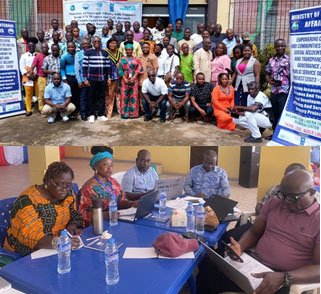
The Ministry of Internal Affairs (MIA), with support from the government, UNDP, and UN Women, has launched a five-day onboarding training in Zwedru, Grand Gedeh County.
The training, according to a release, is to establish County Development Planning Units in Grand Gedeh, River Gee, Maryland, Grand Kru, and Sinoe counties.
The initiative is part of Decentralization Support Program, and the UN Peacebuilding Fund project focused on promoting social accountability, and transparency in governance.
Held in Zwedru from 20–24 October 2025, the training convened over 75 County Development Planning Officers, County Officials, Heads of Ministries, Agencies and Commissions (MACs), and facilitators from MIA, Governance Commission, Internal Audit Agency, and the Ministry of Finance and Development Planning.
Several local technicians also participated. The initiative aims to advance the implementation of the Local Government Act (LGA) of 2018, under the theme: “Building a New Liberia through Decentralization.”
MIA Deputy Minister for Operations, Selena Polson Mappy, described the establishment of County Development Planning Units as “a landmark step toward strengthening local governance, and ensuring citizens experience the real benefits of decentralization.”
She underscored the units will serve as the technical arm of county administrations; linking local priorities to national planning and monitoring frameworks.
MIA Assistant Minister for Research and Development Planning, D. Emmanuel Wheinyue, outlined the structure of each unit, which will include five key technical roles: Development Planning Officer, Project Engineer, Data Analyst, Monitoring and Evaluation Officer, and Gender and Social Inclusion Officer.
These professionals, supported by County Development Officers and other local officials, will facilitate the planning, implementation, and reporting of programs and projects under the County Development Agendas.
“These units will bridge the gap between local development aspirations, and the government national agenda by promoting participatory, and accountable planning,” he said.
Additional remarks from the Governance Commission, and the Ministry of Finance and Development Planning, highlighted the importance of coordination, transparency, and accountability in county development planning.
Ministry of Finance Director of Public Service Investment Programs, D. Emmanuel Williams II, described County Development Agendas as “practical roadmaps that connect national policy with community-level needs.”
Williams spoke of the success of decentralization depends on the functionality, and effectiveness of these new units.
UN Women, Program Support Officer Ms. Oretha T. Lah-Bangurah, said the decentralization must reflect the voices of women, youth, and marginalized groups in county plans and budgets.
Madam Bangurah highlighted UN Women’s support through the Peacebuilding Fund project to embed gender-responsive planning, and accountability throughout the planning cycle.
On behalf of UNDP, Interim National Program Coordinator of the LDSP, Eric Boykai, underscored that County Development Planning Units are the link between national vision, and county-level action.
Boykai encouraged participants to use the week’s tools and templates to translate local priorities into implementable projects with clear responsibilities and timelines.
He said the units are critical to advance local governance by formulating inclusive, evidence-based development plans aligned with national priorities, and by ensuring coordinated aid and resource alignment, while monitoring development activities to promote transparency and effective service delivery.
Throughout the week, facilitators from MIA, Ministry of Finance, Governance Commission, Internal Audit Agency, and Ministry of Gender, Children and Social Protection, are guiding modules on inclusive planning methods, Public Sector Investment Program, concept note and proposal development, program budgeting, internal audit and compliance, monitoring and evaluation, and gender-responsive planning and budgeting. Sessions combine presentations with group work and practical use of standard templates, enabling county teams to leave with draft materials ready for refinement and adoption.
The Zwedru onboarding exercise marks the final phase in meeting the legal requirement for the 15 counties to establish County Development Planning Units.
Previous phases saw six units established in December last year, and four more in May 2025. With this Southeastern cohort, the nationwide rollout is now complete.
With core teams trained, roles defined, and tools in place, counties are now positioned to deliver services closer to communities, strengthen transparency and accountability in local development, and align county priorities with national policy through County Development Agendas.
As the week concludes, participants will complete a post-training assessment and finalize next-step actions with their County Development Officers and Superintendents.
Through this joint effort by MIA, UNDP, and UN Women, supported by the United Nations Peacebuilding Fund and the government counterpart funding, Liberia takes a practical step toward making decentralization work for every county and every community.