By: Godgift Harris
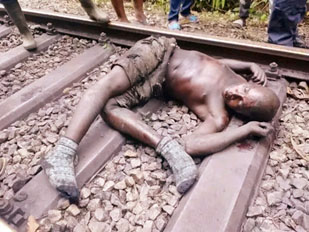
Residents of Todee Statutory District in Montserrado County woke up Thursday morning to a disturbing discovery that has reignited long-standing concerns about safety along Liberia’s railway corridors.
The lifeless body of a man locally known as “Mano Boy” was found lying on a railway track in the district, sparking anger among community members who say the tragedy reflects years of government neglect and inadequate safety measures by the company operating the railway.
According to eyewitness accounts gathered from residents, the victim is believed to have been struck by a train at approximately 2:00 a.m. on March 12, 2026.
The incident occurred along a section of the railway that cuts through several populated communities in Todee, an area residents say has become increasingly dangerous due to the absence of basic protective infrastructure such as warning systems, fencing, or access roads.
The death has triggered widespread outrage across the district, with citizens accusing authorities of ignoring repeated warnings about the dangers posed by trains passing through residential communities without proper safeguards.
Residents said the grim discovery was made early Thursday morning when locals traveling along the railway corridor stumbled upon the body lying on the track.
Word quickly spread throughout nearby communities, drawing crowds of shocked residents to the scene.
Many described the moment as both heartbreaking and infuriating, noting that the railway runs dangerously close to homes and walking paths used daily by villagers.
“We woke up to see the body lying right on the track,” one resident recounted.
“This is not the first time something like this has happened here.”
Community members said the victim, widely known in the area by his nickname “Mano Boy,” was a familiar figure within the district.
His sudden and violent death has left many residents grieving while also raising questions about whether the tragedy could have been prevented.
Angry residents say the death highlights what they describe as the failure of the Government of Liberia to regulate railway operations in communities where people live and work close to the tracks.
The railway network in Liberia, primarily used to transport iron ore from mining areas to the coast, passes through several rural communities in Montserrado and neighboring counties.
However, residents argue that little attention has been given to protecting the lives of those living along the railway corridor.
Many believe the Chinese company operating the railway has not done enough to ensure the safety of communities located near the line.
Residents are now demanding immediate intervention from authorities, calling for stronger safety regulations and infrastructure improvements.
“We are tired of losing our loved ones to these train accidents,” a frustrated community member said during an interview.
“The government must act now and work with the company operating the train to ensure safety for people living in this area.”
Among the key demands being raised by residents is the construction of a separate access road alongside the railway track.
According to community members, many villagers are forced to walk along or cross the railway line because there are no alternative roads connecting their communities.
This situation, they say, increases the risk of accidents, particularly at night when visibility is poor.
Local leaders argue that building a proper road parallel to the railway would significantly reduce the danger posed to residents who currently rely on the track as a pathway.
“We need a road beside the track,” another resident emphasized.
“People walk on the railway because there is no other way to move between communities.”
Community members also called for the installation of warning signals, barriers, and security patrols along the railway corridor.
Rising Fear and Insecurity
Beyond the tragic death itself, the incident has also exposed broader security concerns in the district.
Residents say Todee Statutory District has been experiencing a growing wave of criminal activities, while law enforcement presence remains minimal or nonexistent.
Frank Kollie, a resident of the district, told journalists that the community is living in constant fear due to the lack of security.
“We are living here without security presence in the district,” Kollie said.
“We are living only by the grace of God” he added that criminal activities have been increasing in the area, leaving residents vulnerable and uncertain about their safety.
According to Kollie, the absence of police patrols and other security institutions has made it difficult for residents to feel protected, especially during nighttime hours when many incidents occur.
Residents insist that the death of “Mano Boy” is not an isolated incident, claiming that several people have previously lost their lives along the same railway corridor.
Community members say they have repeatedly raised concerns about the safety risks posed by trains traveling at high speeds through populated areas.
However, they claim their appeals have largely gone unanswered.
“This is not the first time we have seen a dead body on the train track,” one resident lamented.
“People keep dying, but nothing changes” the repeated incidents have created a sense of frustration among residents, many of whom believe authorities only respond after tragedies occur rather than taking proactive measures to prevent them.
Silence from authorities
as of Thursday morning, officials from the Government of Liberia had not issued an official statement regarding the incident.
Local authorities in Montserrado County have yet to provide details about the circumstances surrounding the death, including whether foul play may have been involved or whether the victim was indeed struck by a passing train.
Police sources, however, confirmed that an investigation is ongoing to determine the exact cause of death.
The body is expected to be examined by authorities as part of efforts to establish what happened during the early hours of the morning.
Railway Safety Under Scrutiny
The tragedy has once again placed Liberia’s railway safety standards under scrutiny.
Across several counties, communities located along railway lines have long complained about the absence of protective measures such as a warning signals, crossing barriers
Security patrols, fencing around railway corridors, without these safeguards, residents say pedestrians including children are frequently exposed to danger.
Critics argue that while railway operations contribute significantly to Liberia’s mining economy, the safety of ordinary citizens living along the railway has not received equal attention.
Following Thursday’s incident, community members in Todee are urging the government to take swift action before more lives are lost.
Residents say authorities must immediately engage with the railway operator to implement stronger safety measures across the corridor.
Among their demands are:
Construction of roads alongside railway lines
Installation of warning systems and barriers, deployment of security personnel
Increased monitoring of train operations in residential areas
Community leaders warn that if nothing is done, similar tragedies will continue to occur.
“This should be the last death we see on this track,” one elder in the district said.
As the investigation continues, residents of Todee remain shaken by the tragic discovery that has once again exposed the dangers lurking along Liberia’s railway corridors.
For many, the death of “Mano Boy” is more than a personal tragedy it represents what they see as a broader failure of governance, infrastructure planning, and public safety enforcement.
Until authorities respond with concrete measures, residents say they will continue to live with the fear that the railway passing through their communities could claim another life at any moment.