By: Yassah J Wright
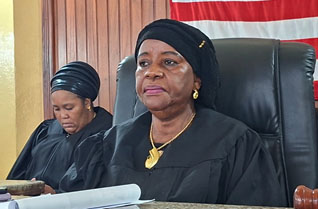
The Criminal Court “B” assigned Judge, Mameita Jabateh-Sirleaf, has called on the Government of Liberia to increase budgetary allocations to the Judiciary, warning that without sustained investment in legal training and institutional reform, the country’s rule of law will remain fragile.
Speaking during the opening of Criminal Court “A” “B” “C” “D” & “E” at the February Term of Court, A.D. 2026, for the First Judicial Circuit in Montserrado County, Judge Jabateh-Sirleaf stressed that effective justice delivery depends on well-trained lawyers, a reformed judicial system, and unwavering respect for the rule of law.
“Lawyers are central to protecting human rights, ensuring fair trials, and safeguarding democracy,” the Judge said, noting that these responsibilities cannot be meaningfully fulfilled without adequate resources and continuous professional development.
Judge Jabateh-Sirleaf emphasized that increased funding should go beyond salaries and infrastructure, and instead prioritize continuing legal education, ethics training, and modern judicial administration.
Acting under the mandate of Chief Justice Yamie Quiqui Gbeisay Sr., she formally declared the February Term of Court, A.D. 2026, for Criminal Assizes A, B, C, D, and E of the First Judicial Circuit officially open.
According to her, properly trained lawyers are better positioned to interpret the law, manage cases efficiently, and uphold ethical standards, critical elements in restoring public confidence in Liberia’s justice system.
She said strengthening the Judiciary through funding is not merely an institutional concern but a national reform priority essential to democratic governance and economic development.
The Criminal Court “B” Judge reiterated that the rule of law remains the foundation of Liberia’s constitutional order, stressing that all persons, including public officials, are subject to the law.
She described lawyers as guardians of the rule of law, tasked with defending constitutional rights and ensuring equality before the law, while calling for reforms that promote transparency, accountability, and consistency in judicial decision-making.
She noted that a weak justice system undermines social stability and public trust in state institutions.
Judge Jabateh-Sirleaf also called for stronger reforms within the legal profession, urging lawyers to uphold the highest ethical standards, avoid conflicts of interest, and conduct themselves in ways that enhance respect for the courts.
She emphasized the need for reforms that strengthen disciplinary mechanisms, improve case management, and promote open access to court decisions as part of a broader transparency agenda.
Highlighting the challenges posed by Liberia’s dual legal system, Judge Jabateh-Sirleaf noted that the coexistence of statutory and customary laws continues to create inconsistencies, particularly in land, marriage, and inheritance matters.
She cited the 2013 Land Rights Act and the 2001 Inheritance Law, observing that although these laws guarantee equal rights, weak implementation and limited legal awareness, especially in rural communities, remain major obstacles.
According to her, a reformed and well-resourced Judiciary, supported by trained lawyers, is essential to harmonizing customary practices with constitutional guarantees and protecting vulnerable groups.
Judge Jabateh-Sirleaf further called for increased support for public defenders and legal aid institutions, stressing that access to justice must not be determined by economic status.
She advocated comprehensive legal education reforms, including updated curricula, expanded clinical legal training, and mandatory continuing education, as part of a long-term strategy to strengthen the rule of law.
Judge Jabateh-Sirleaf urged all stakeholders, government, lawyers, judges, and civil society, to work collectively toward meaningful judicial reform and a stronger rule of law.