By: Godgift Harris
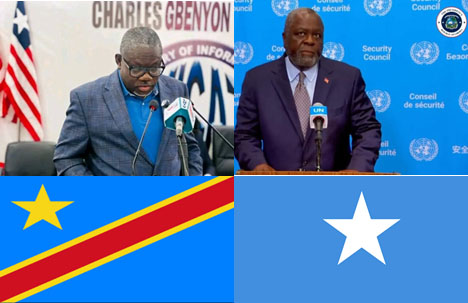
The Government of Liberia has swiftly clarified growing public confusion surrounding a recent statement delivered at the United Nations Security Council (UNSC) by Liberia’s Permanent Representative to the UN, Ambassador Lewis Brown.
Concerns have aroused amid questions over whether the remarks reflected Liberia’s independent foreign policy position or a broader African consensus.
The controversy followed Ambassador Brown’s reading of a statement at the Council that touched on international law, sovereignty and accountability, at a time when the United States announced criminal charges against Venezuelan President Nicolás Maduro, his wife Cilia Flores, their son, and several associates.
The group is accused of collaborating with international drug cartels to facilitate the shipment of large quantities of cocaine into the United States, charges that could carry life sentences if convictions are secured.
President Maduro was expected to appear in a U.S. federal court in New York on January 5, 2026, setting the stage for what legal analysts predict will be a prolonged judicial battle over jurisdiction and immunity.
In the aftermath of the UNSC session, public debate intensified in Liberia, with critics questioning whether Ambassador Brown’s remarks signaled a new foreign policy direction for the country particularly as Liberia marks its return to the Security Council after more than 64 years.
Speaking Tuesday at the Ministry of Information’s regular press briefing, Information Minister Jerolinmek M. Piah sought to distance the Liberian government from claims of unilateral positioning.
He stressed that the statement read by Ambassador Brown did not represent Liberia alone, but rather a collective position of the A3 bloc, the three African countries currently serving on the Security Council.
“That statement was a collective effort of the three African countries on the Council,” Minister Piah clarified.
“It was not Liberia’s standalone statement. Ambassador Lewis Brown only read it on behalf of the A3.”
Public Misinterpretation Raises Transparency Concerns
The clarification, however, seems to have done little to quiet criticism.
Media commentators and civil society actors have argued that the government’s delayed response has exposed weaknesses in public communication and transparency, particularly at a moment when Liberia’s diplomatic posture is under heightened domestic and international scrutiny.
Observers have noted that while bloc diplomacy is standard practice within the UN system, especially among African states, the failure to clearly distinguish between national and collective positions risks misleading the public and international partners alike.
“Liberia’s return to the Security Council comes with expectations,” one foreign policy analyst noted.
“Clarity about when Liberia is speaking for itself and when it is speaking for Africa is not optional, it is essential.”
Symbolism Versus Substance
During the briefing, Minister Piah highlighted portions of the A3 statement that praised outgoing Security Council members- Slovenia, Algeria, Guyana, Sierra Leone, and the Republic of Korea and congratulated Somalia on assuming the Council’s presidency.
The statement also framed Liberia’s return to the Council as a symbolic milestone, referencing the hoisting of Liberia’s flag at UN headquarters and linking the moment to President Joseph Nyuma Boakai’s vision of peace as both a “privilege and a duty.”
It further recalled the 2018 withdrawal of the United Nations Peacekeeping Mission from Liberia and cited more than two decades of post-war stability following the 2003 Comprehensive Peace Agreement as evidence of democratic resilience and institutional reform.
Yet, critics have cautioned that symbolic language and diplomatic ceremony must be matched by clear policy positions and tangible contributions especially as Liberia continues to grapple with economic hardship, weak public services, and persistent governance challenges at home.
Africa’s Seat, Liberia’s Responsibility
While the A3 statement emphasized that “the nameplate will read Liberia, but the seat is Africa’s,” analysts have argued that Liberia must still define its own priorities, red lines, and voting behavior within the Council, beyond collective African positions.
Liberia secured its non-permanent seat with the backing of 181 UN member states, a mandate the government described as a vote of global confidence.
Civil society groups, however, have insisted that such confidence carries increased responsibility, both internationally and domestically.
As Liberia settles into its role on the Security Council, the controversy surrounding the A3 statement underscores a broader challenge, the need for consistent, transparent communication about Liberia’s voice, influence, and independent stance within one of the world’s most powerful decision-making bodies.
Whether Liberia can convert its historic return into meaningful diplomatic leadership beyond symbolism and ceremony remains an open question, closely watched at home and abroad.