By Godgift Harris
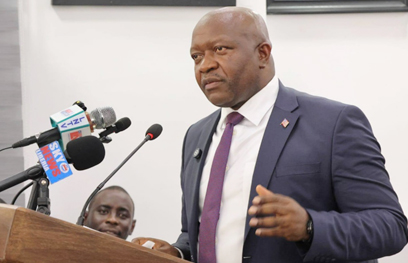
Shortly after Finance Minister Augustine Kpehe Ngafuan confidently declared that the economy is “on a solid track,” public frustration and key economic indicators paint a much more uncertain picture of the financial health.
Ngafuan made the disclosure at the Ministry of Information press briefing on Monday, November 10, 2025.
He assured the public that there would be no risk of a budget shortfall, noting that the country US$1.2 billion national budget remains stable.
Ngafuan credited the strong revenue performance of the Liberia Revenue Authority (LRA), and dismissed claims that the budget was artificially inflated by ArcelorMittal US$200 million signature bonus.
He added: “Even without ArcelorMittal’s contribution, the fiscal strength remains above the billion-dollar mark.”
However, economists, civil society leaders, and financial observers, have challenged the narrative.
They warned that government’s optimism fails to account for persistent inflation, mounting debt, and a sharp decline in living standards.
“The government may be collecting more revenue, but the lives of the people are not improving,” said one Monrovia-based economist, who preferred anonymity.
“Prices for essential commodities and transportation continue to rise, while wages remain stagnant.
That is not economic progress; that is economic illusion.”
LRA Commissioner General James Dorbor Jallah, supporting Ngafuan’s assertions, said the Authority performance has been strong.
“ArcelorMittal just added more flavor to our billions,” he remarked, suggesting that domestic revenue mobilization is robust and sustainable.
But critics argue that increased tax collection does not necessarily reflect real economic growth. Much of the reported revenue, analysts note, comes from higher import duties, fuel surcharges, and business taxes costs that are eventually passed on to ordinary Liberians.
Furthermore, the country continued dependence on extractive industries and foreign concession payments remains a cause for concern.
Non-mining sectors such as agriculture, small manufacturing, and services are struggling to expand, leaving thousands without stable employment opportunities.
But Ngafuan highlighted a US$2.3 million allocation to the Assets Recovery and Property Retrieval Taskforce, a move he said, underscores government’s commitment to fight corruption.
Some civil society voices question whether the initiative is a genuine accountability effort or a politically selective tool.
Meanwhile, Liberia continues to grapple with a rising fiscal deficit, heavy external debt servicing, and dependency on donor support.
IMF has repeatedly cautioned that without deep structural reforms in governance, infrastructure, and human capital development, Liberia could face renewed macroeconomic instability.
Despite these warnings, Mr. Ngafuan remains upbeat.
“Too many good things are happening,” he said, maintaining that “there was no shortfall last year, and there will be no shortfall this year.”