By: Yassah J Wright
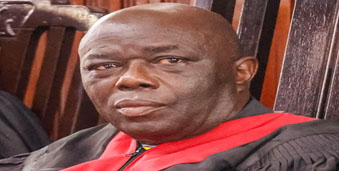
Chief Justice Yemie Quiqui Gbeisay has challenged critics:” Anyone who has evidence that Chief Justice Gbeisay or any member of the Bench is corrupt has a right under the freedom of speech to criticize and persuade the legislature to impeach the justice concerned and subsequently subject him/her to prosecution.”
The Chief Justice echoed the challenge during the opening of the March Term in 2026 of the Supreme Court on Capitol Hill in Monrovia.
The Chief Justice’s challenge has come in the wake criticism that aroused against the most talked-about contempt proceedings against Mr. Justin Opa Yeazean of Ziah Town, Tappita District, Nimba County.
In what appears to be a landmark opinion delivered on February 13, 2026, the Court interpreted Article 15 (a) of the 1986 Liberian Constitution together with Article 5 and 14 of said Constitution: “Anyone who has evidence that Chief Justice Gbeisay or any member of the Bench is corrupt has a right under the freedom of speech to criticize and persuade the legislature to impeach the justice concerned and subsequently subject him/her to prosecution,” Chief Justice Gbeisay clarified.
For clarity, he noted that the Supreme Court deems it necessary to quote said Article 15 (a) of the Liberian Constitution in response to critics’ debate that has come from the court’s ruling which has incarcerated ‘Prophet Key’ at the Monrovia Central Prison.
According to him, the Constitution provides: “Every person shall have the right to freedom of expression, being fully responsible for the abuse thereof.”
The Chief Justice said in the Court’s determination, nothing in this world is absolute; so, it is with Article 15 of the Liberian Constitution, which guarantees freedom of speech.
He said the authors of the Constitution, in their wisdom, set a limit, that limit is “being fully responsible for the abuse thereof.”
According to him, the authors of the Liberian Constitution contemplated and anticipated the abuse of freedom of speech. The February 13, 2026 opinion, he noted, made it clear that engaging in vulgarity, profanity, and naked abuse and description of women’s private parts on social media is an abuse of the freedom of speech as guaranteed by Article 15 (a) above.
Chief Justice Gbeisay stated that the Opinion declared that this was not, is not, and could never have been the intent of Professor Dr. Amos C. Sawyer, Mr. D.K. Wonsehleay, and the gallant men and women who authored the Liberian Constitution.
Article 15 of the Constitution, he said, was intended to allow positive engagement and the exchange of ideas for the healthy growth and development of the Liberian democracy, because agreement and disagreement are integral parts of democratic governance.
Article Five (5) (b) of the same Constitution provides that: “the Republic shall preserve, protect and promote positive Liberian culture, ensuring that traditional values which are compatible with public policy and national progress are adopted and developed as an integral part of the growing needs of the Liberian society.”
The Chief Justice narrated that this provision empowers the government to preserve positive customs and traditional values for Liberians and their generation unborn.
Article 14 of the Constitution also reads thus: “All persons shall be entitled to freedom of thought, conscience and religion and no person shall be hindered in the enjoyment thereof except as may be required by law to protect public safety, order, health, or morals or the fundamental rights and freedoms of others.”
Clearly, Chief Justice Gbeisay indicated that the authors of the Liberian Constitution gave a caveat “except as may be required by law to protect public safety, order, health, or morals or the fundamental rights and freedoms of others.”
The use of vulgarity and profanity, he said, is certainly not a positive value to be preserved by the government.
The use of these words on social media by a Liberian citizen, he also noted, is a total madness and degrades Liberia and Liberians, thereby shaming Liberia as a member of the comity of civilized nations.
“As a native man born in a village, I can recall vividly that when a grown man stands out publicly in a traditional town and utters such a degree of profanity as uttered by Mr. Yeazean over the years, he is immediately restrained by the men of the village and taken to the shrine of the elders, and thoroughly reprimanded; the same applies to the women,” Gbeisay emphasized.
The Supreme Court Opinion has therefore clarified in no uncertain terms that vulgar language, profanity, and the outright abuse of men and women in Liberia is illegal, wrongful, and was never the intent of the writers of the Liberian Constitution.
Chief Justice Gbeisay stressed that non-lawyers should note that when the Supreme Court speaks, it automatically becomes law with the force and effect of any law passed by the legislature.
In said opinion, he said the Supreme Court of Liberia, in its power as the final arbiter and interpreter of the Constitution, determined that it has the power and authority not only to punish contempt, but also to determine what constitutes contempt, and that the action of Mr. Yeazean in attacking Justices of the Supreme Court Bench without evidence and raining insults was intended to bring the Supreme Court to public disrepute and erode public confidence in the Court.
Chief Justice Gbeisay further said consequently, Mr. Yeazean appeared before the Court in line with due process of law, pleaded for the mercy of the Court, and based upon his plea, the Court adjudged him guilty of contempt.
The Court, however, tendered justice with mercy and sentenced him to six months’ conditional imprisonment. Mr. Yeazean will serve his imprisonment term; at the end of which he will publish, in three widely circulated newspapers for five (5) consecutive days, an apology to the Supreme Court and the Liberian people; following which he will also file a behavior bond clearly committing himself never, ever, to use such vulgarity and profanity against any person.
“We acknowledge with thanks and appreciation, Counsellors Tiawan Saye Gongoloe, Kanio Gbai Gbalah, Arthur Johnson, Lawrence Suah, Saymah Serena Cephus, and all other counsellors who went the extra mile to educate the Liberian people on contempt proceedings,” the Chief Justice noted.
The power of the Court to protect itself through contempt proceedings is horrid with age for centuries now, he indicated.
“Distinguished Ladies and Gentlemen, you need not be told that our country has been perceived in recent history as a lawless nation in the sub-region. Something has to be done to bring our people to civility. Now that the Supreme Court of Liberia has unequivocally defined the limit of our freedom of speech, there is a common saying that one parent cannot train a child,” Chief Justice Gbeisay noted.
He said in its power to interpret the Constitution and the laws of Liberia, the Supreme Court, having clearly declared that profanity and vulgarity are not freedom of speech, they now encourage the other two branches of government to employ appropriate disciplinary measures to discipline those in their employ who may want to use vulgarity as a means of expressing themselves, to bring them to book. “In my humble opinion, there is absolutely nothing in the law that gives any government official, irrespective of his/her status, immunity for using vulgarity and profanity in the public glare against any Liberian,” he noted.
Chief Justice Gbeisay stressed that the Court is opened and prepared to take action when properly in venue before it, as the inherent power of the gavel is to discipline and preserve law and order.
With these brief remarks, Chief Justice Gbeisay then declared the March A.D. 2026 Term of the Honorable Supreme Court of Liberia opened.