By Yassah J. Wright
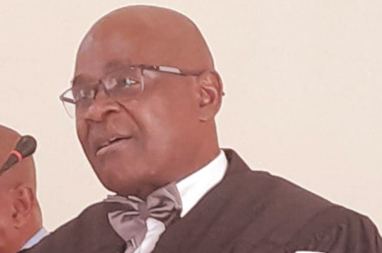
Claims of violation of universal human rights to health requests are currently being made against Chief Justice Yamie Quiqui Gbeisay.
These allegations against Justice Gbeisay are coming from the Assigned Judge George W. Smith of the 12th Judicial Circuit, Grand Kru County.
While addressing judges, lawyers and judicial staff on Monday, November 9, at the official opening of courts throughout the country, Judge Smith drew his audience attention to Chief Justice Gbeisay alleging that he violated his (Smith) human rights on health ground.
“I am impelled to make this disclosure, in excise of my constitutional right to free speech, to give notice to all, particularly the Chief Justice, that the violation of Judge Smith and his family universal human rights to health will not absolve him from legal liability in his personal capacity in the event I am seriously harmed,” Smith reminded his audience.
He added: “I underwent a critical medical operation/procedure. Prior to that, I appealed to Chief Justice Gbeisay to assign me to a circuit near Monrovia where my doctor is, or at least, a circuit to give me access to referral hospital other than the Circuits of Grand Kru, Sinoe and River Gee,” Smith claimed.
He said the Chief Justice refused to honor his request, apparently under the pretext of bringing reform to the judiciary/rebranding the judiciary and maintaining work ethics, and discipline in the judiciary.
While the Chief Justice is yet to respond to Judge Smith allegation, Smith noted: “After Gbeisay denied my request, I reminded him to have the judiciary refund my US$3,280, with the acquiesce of the Court Administrator (CA), to pre-finance some works at the Civil Law Court where I was then assigned. “
Smith noted that the Chief Justice promised to discuss that request with the Court Administrator and revert to him.
“I informed him that I urgently needed this money to underwrite my medical expenses, among other things, but he refused to honor my request. When I was discharged from the hospital, I reminded him. Knowing that I was about to leave Monrovia for assignment, not even showing the least empathy for my medical condition, he demanded me to write a formal letter to him.”
“This is not a good faith judicial reform/rebranding of the judiciary and maintain workplace ethics in the judiciary, Smith told his audience.
“This is excessive abuse of power, an ardent desire to flex power. This is oppression, suppression and authoritarianism, the enforcement or advocacy to strict obedience to authority at the expense of personal freedom.”
The Liberian Constitution does not explicitly grant judges medical treatment in a specific article. However, Article 8 generally mandates that the country shall promote safety, health, and welfare facilities for all citizens, which can be interpreted to include judicial officials. The right to medical treatment for judges is more likely to be established through existing laws and regulations passed by the legislature, rather than being directly stated in the constitution itself.