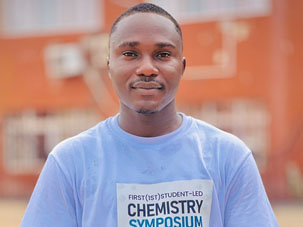
Liberia has successfully hosted its first-ever student-led Chemistry Symposium in Gbarnga, Bong County. The exercise made what many education stakeholders described as a major step forward for practical science and STEM education. STEM education is a teaching approach that integrates four specific disciplines: Science, Technology, Engineering, and Mathematics, into a single, interdisciplinary learning model. Instead of teaching these subjects in isolated blocks, it emphasizes real-world applications and hands-on, problem-based. The symposium, organized by Liberian Chemistry educator, Adam J. Kallon, brought together more than 750 students from grades 10th through 12th under the theme: “Applying Chemistry for Problem Solving, Innovation and Sustainable Development.” The initiative was designed to address persistent challenges affecting hands-on Chemistry education, including the lack of functional laboratories, inadequate science equipment and chemicals, overcrowded classrooms, and limited professional training opportunities for science teachers. The organizer said, these barriers often force students to learn Chemistry theoretically rather than through experimentation and practical inquiry. During the symposium, students showcased practical Chemistry demonstrations focused on solving real-world problems. Presentations included water purification through filtration, acids and bases using natural indicators, gas-producing chemical reactions, energy changes in reactions, soap making through saponification, reaction-rate experiments, and Chemistry applications in sustainable agriculture. Mr. Kallon spoke about the vision behind the initiative, which was created to move students beyond theoretical learning and encourage scientific inquiry, creativity, and innovation through hands-on experiences. He described the event as a platform that will students build confidence in Chemistry and other STEM disciplines while promoting problem-solving and sustainable development. The symposium, Kallon said, also aligns with the Ministry of Education’s Chemistry curriculum objectives, which emphasize laboratory skills, critical thinking, research, creativity, and the practical application of scientific principles.
Participants and education observers praised the event for encouraging experimentation, student-led inquiry, and collaborative learning.
Many of them described it as a “pioneering science initiative that could help strengthen the STEM culture and inspire a new generation of scientists, innovators, and researchers.
Kallon meanwhile, expressed hope that the Student-led Chemistry Symposium will grow into a national movement connecting students, teachers, universities, policymakers, and development partners in advancing science education in the country.