By: Domingo Dargbeh
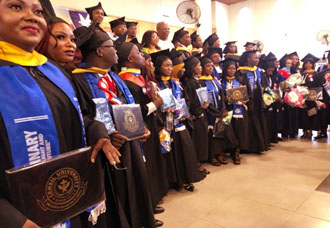
Weekend atmosphere in Paynesville turned celebratory as Censil University conferred degrees and certificates on thirty-nine graduates across education, business, and health sciences, marking its sixth commencement convocation since its establishment in 2015. The ceremony, held at Effort Baptist Church, drew families, clergy, academics, and community leaders who gathered to witness what university officials described as “another step in building a generation of service-driven professionals.”
Presenting the graduates to the Board of Trustees, Vice President for Academic Affairs Alex Korkolea outlined the academic distribution, emphasizing that the institution’s growth is reflected in the diversity of disciplines. According to him, twenty-eight students from the Mother Kolu K. Kalama College of Health and Environmental Sciences earned associate degrees, twelve from the Nellie K. Tokpah College of Education received C Certificates in General Education, and one graduate from the Edward B. Tokpah College of Business and Technology obtained a bachelor’s degree.
University administrators described the figures not merely as statistics but as “evidence that the university’s practical training model is gaining relevance in Liberia’s workforce.” Officials noted that the strong showing from the health sciences program reflects rising demand for trained professionals in community health and environmental management.
Delivering the keynote address, commencement speaker Rev. Mrs. Neidah G. Lablah, founder of Divine Grace Anointing Deliverance and Healing Ministries, challenged graduates to view their education as a responsibility rather than a personal trophy. “A certificate should never be a decoration on your wall,” she declared. “It must be a tool in your hand, shaping lives and changing conditions wherever you stand.”
A Call to Shine Beyond Degrees and Certificates
Speaking on the theme “Shine Out Your Light,” Rev. Lablah told the graduates that their greatest achievement was not the degrees they received but the values forged through struggle and discipline. “Your light is not your title,” she said. “It is your integrity, your compassion, and your willingness to serve when no one is applauding.”
She urged the new alumni to anchor their future on five guiding pillars—competence, commitment, character, connection, and contribution—stressing that Liberia’s development depends on graduates who can translate knowledge into solutions. “Competence is not about occupying a seat,” she noted. “It is about filling that seat with innovation, responsibility, and results.”
On commitment, the preacher reminded graduates that success is often forged in quiet sacrifice. “History remembers the teacher who stayed late, the nurse who stood firm in crisis, and the entrepreneur who refused to surrender to failure,” she told the audience, adding that perseverance will distinguish professionals in a challenging economic environment.
She further warned that character will ultimately define the graduates’ legacy. “Degrees introduce you to opportunity,” she emphasized, “but character decides whether opportunity stays.” According to her, honesty and humility remain the most reliable currency in societies battling corruption and mistrust.
Rev. Lablah also highlighted the power of relationships, urging graduates to build networks that uplift rather than divide. “No light shines in isolation,” she said. “When you lift others, your influence multiplies, and your purpose becomes larger than your profession.”
Leadership and Responsibility Beyond Graduation
Concluding her address, she encouraged the graduates to view service as the ultimate proof of education. “If your learning does not improve a life, then it has not reached its full meaning,” she declared, urging them to “shine for Liberia, shine for humanity, and shine where hope is needed most.”
In separate remarks, Board Chairman Rev. J. Andrew Lablah reaffirmed the trustees’ commitment to strengthening the institution. “This university will remain a beacon of excellence, innovation, and integrity,” he said, adding that the board stands aligned with the administration’s vision to expand quality higher education opportunities.
Addressing the graduating class, the chairman described their success as both personal and national. “Your education is not only your asset,” he told them. “It is a torch that lights pathways for communities and generations yet unborn.” He urged the graduates to carry the university’s reputation with pride while ensuring their impact is measured by service to society.
The ceremony closed with applause, prayers, and photographs as the Class of 2026 exited the sanctuary amid cheers from relatives and faculty. For many in attendance, the message of the day was clear: the true value of graduation lies not in the ceremony itself, but in how its recipients illuminate the future beyond it.