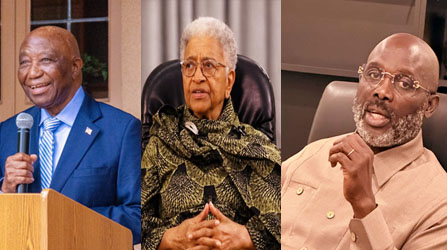
“Our presidents, Sirleaf, Weah and Boakai don’t seem to have a unified direction on where they want this nation to go. Instead of criticizing each other or policies, they need to come together at an elders’ round table to look ahead,”
– a local businessman.
Recent political ‘war of words’ has reportedly developed into bad blood among the country’s three main actors.
The situation has gone to the extent that former President Ellen Johnson Sirleaf, has accused Boakai’s administration of being passive in the fight against corruption.
She among other vices, labelled Monrovia a “very dirty city.”
For George Weah, the division is about his perceived personal generosity to so many high profiled individuals, including President Joseph Nyuma Boakai and some lawyers or doctors.
With that unfolding division, former President George Weah launched a fresh political criticism against Pres. Boakai.
Weah accused Boakai of “harboring personal hostility while he benefited from my goodwill.”
The remarks, delivered on Sunday, May 3, 2026, have intensified tensions between the two dominant political camps.
The two parties are the opposition Congress for Democratic Change (CDC and the governing Unity Party (UP).
Weah made the comments during the dedication of a newly constructed media complex owned by Royal Communications Incorporated in Paynesville, outside Monrovia.
The event, which was intended to celebrate expansion in the media sector, quickly turned into a platform for political confrontation.
While addressing a crowd of supporters and media practitioners, Weah accused the ruling UP-led government of sustaining a “pattern of antagonism towards him.”
He claimed that despite his efforts to maintain cordial relations, Pres. Boakai continues to view him as a ‘political enemy.’
“Joseph Boakai is the only person, who thinks I’m his enemy, but when he was sick, I took him to the hospital,” Weah told his supporters to a deafening round of jeers.
The statement rapidly gained traction across the political landscape, sparking debate among supporters and critics of the pair.
Weah’s comments came as he officially dedicated the headquarters of Royal Communications Inc., operators of Kings FM, City FM, and Clar TV.
He praised the role of his media institutions in contributing to post-war media recovery and development.
Weah, however, used the occasion and blamed an alleged “political interference in the operations of his media outlets.
He claimed that his institutions were previously forced to relocate due to pressure from the ruling establishment.
The allegation, though unverified, has deepen and fueled political bad blood that has emboldened foot soldiers to join the fray.
In defending his legacy, Weah highlighted his longstanding commitment to education and human capital development.
He named several current and former public officials, including Nathaniel McGill, Samuel Tweah, Pepsi Yekeh, and Safua Mai Gray, as beneficiaries of his “scholarship initiatives.”
“I have done a lot for people in the education sector, including doctors and lawyers,” Weah said.
He insisted that his contributions have often been overlooked by critics, who “question my time in office.”
Weah also portrayed himself as a leader “committed to integrity and accountability.”
He denied ever using public funds to support his private ventures, including his media enterprises.
“Not because I was president, would I take the Liberian people’s money to fix King’s FM.”
Despite these assertions, the government responded swiftly with strong criticism of Weah’s remarks.
Deputy Information Minister Daniel O. Sando, described Weah’s conduct as “embarrassing and irresponsible.”
Sando’s response signals the administration’s firm stance against “provocative political rhetoric.”
The criticism reflects a broader trend within the Boakai administration of directly confronting opposition narratives.
Assistant Foreign Minister for Public Affairs Saywhar Nana Gbaa, also dismissed Weah’s claims.
Madam Gbaa questioned inconsistencies in Mr. Weah’s statements, and meanwhile, challenged his portrayal of past generosity.
Her response underscores the widening communication gap between the ruling government and the opposition.
As the war of words intensifies, neither side appears willing to de-escalate.
The latest confrontation highlights an enduring rivalry that continues to shape Liberia’s post-election landscape; with both leaders have maintaining firm positions as the country faces a political climate marred by sharp divisions and heightened rhetoric.
As citizens begin to notice the negative tunes in leadership, both past and present, a very prominent Liberian business entrepreneur had this to say: “Our presidents, Sirleaf, Weah and Boakai don’t seem to have a unified direction on where they want this nation to go. Instead of criticizing each other or policies, they need to come together at an elders’ round table to look ahead.”