By: Godgift Harris
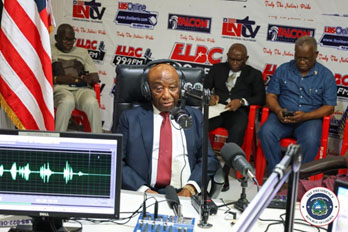
President Joseph Nyuma Boakai has sparked public debate after openly criticizing the content of many local radio stations.
President Boakai told journalists he and his family now listen only to the British Broadcasting Corporation (BBC) and ELWA Radio because of what he described as increasing rudeness and personal attacks on Liberia’s airwaves.
“I don’t listen to radio besides the BBC and ELWA, too much rudeness on these radio stations,” President Boakai said during an interview on state radio on Friday, December 19, 2025
While acknowledging that radio remains the most influential source of information for many Liberians, the President expressed concern that some broadcasters have strayed from their core responsibility of public education.
He argued that instead of informing and enlightening the public, certain radio programs are being used to insult individuals for personal or political gain.
President Boakai emphasized that radio plays a critical role in shaping national discourse, particularly in a country where many citizens rely on radio as their primary source of news.
He urged media institutions and broadcasters to uphold professionalism, factual reporting, and ethical standards, stressing that the airwaves should promote civic education, national unity, and respect rather than division.
His remarks, however, have drawn mixed reactions from journalists, civil society actors, and ordinary Liberians.
Critics argue that the President’s dismissal of local radio undermines a key platform through which citizens express grievances and hold leaders accountable.
Some Liberians say the President’s comments suggest a growing disconnect between national leadership and grassroots concerns.
“If the President does not listen to local radio, then he is not hearing the cries of ordinary Liberians,” one media advocate said.
Others argue that local radio stations often serve as the only channel through which rural and marginalized communities can communicate their challenges to government.
There are also concerns that the President’s stance could influence the attitude of other government officials toward local media.
Media practitioners warn that if the Head of State publicly downplays the importance of local radio, officials may feel less obligated to engage with or respond to issues raised on community-based stations.
Supporters of the President, however, say his comments should be viewed as a call for reform within the media sector, not an attack on press freedom.
They argued that improving standards and ethics in broadcasting would strengthen, rather than weaken, Liberia’s democracy.
President Boakai did not directly address concerns related to newspapers or print media during the interview.
His comments have nonetheless reignited a broader national conversation about media
ethics, regulation, professionalism
And the balance between free expression and responsible journalism in Liberia’s vibrant but often controversial radio landscape.