By: Amos Harris
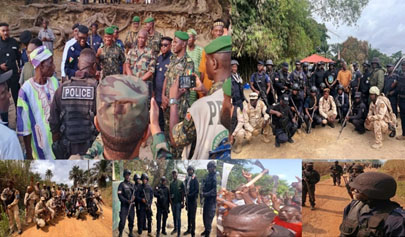
The recent reported incursion of armed Guinean soldiers into Liberian territory in Foya District, Lofa County, has sparked growing anxiety among citizens and renewed national debate about the safety and sovereignty of Liberia’s borders.
The crossing of armed troops from Guinea into Liberia territory, accompanied by the hoisting of a foreign flag on Liberian soil, has left residents unsettled and raised serious concerns about the country’s ability to protect its territorial integrity.
For many Liberians, the question now being asked across towns, villages, and urban communities is simple but profound, is Liberia safe?
A Troubling Border Incident
According to reports from local residents in Foya District near the Liberia Guinea border, armed Guinean soldiers allegedly crossed into Liberian territory on March 10, 2026, and raised the Guinean national flag in what many locals interpreted as a symbolic claim over the disputed land.
While border tensions between the two neighboring countries are not new, the act of entering another nation’s territory with weapons and replacing its flag carries strong political and historical implications.
In international law and diplomatic practice, raising a national flag in another country’s territory is often interpreted as a declaration of control or assertion of sovereignty.
For citizens who witnessed the incident, the act was seen not merely as a misunderstanding over borders but as a direct challenge to Liberia’s territorial authority.
The situation escalated the following day when a Liberian citizen, identified as 44-year-old Edward Lebbie, was reportedly shot in the left thigh during the confrontation.
Local accounts claim the shooting was carried out by Guinean soldiers operating near the disputed border area.
The incident has intensified fear among residents and heightened calls for immediate government action to protect Liberian citizens living in border communities.
Local Hunters Step Forward
In the absence of immediate visible security presence from the state, local hunters and youth groups began organizing themselves to defend what they describe as their ancestral land.
One of the most prominent figures to emerge from the community response is a well-known traditional hunter from Foya District.
The hunter, whose reputation in the community stretches across several villages, reportedly returned from the forest after hearing that foreign soldiers had entered Liberian territory.
Local residents say he quickly mobilized what they referred to as “Youth in Defense of Foya,” a group of young men prepared to resist any attempt to seize their land.
Standing before a cheering crowd of youth, the hunter declared his determination to defend the territory.
“Our parents left this land with us, we can’t allow anyone to take it, it will never happen,” he said.
“I just came from the bush because the youth called for me.
I brought other hunters with me, I am not leaving here again, we are waiting, let them come back.”
For the residents gathered around him, the hunter’s words carried both symbolic and emotional weight.
In rural communities across Liberia, traditional hunters are often seen not only as providers but also as protectors of community land. His return from the forest to confront what locals see as an invasion reflects a deep cultural instinct to defend ancestral territory.
“Country Gun Medicine”
Perhaps the most striking moment during the gathering occurred when observers asked the hunter about the object he carried on his head, which resembled a horn. He responded confidently, “It is my gun medicine; no bullet can come close.” The statement reflects long-standing traditional beliefs in many rural parts of West Africa, where hunters rely not only on firearms but also on spiritual protection rituals believed to shield them from harm.
While such beliefs may appear symbolic to outsiders, within many communities they serve as sources of courage and unity during times of conflict or uncertainty.
For the youth standing beside him, the hunter’s presence represented resistance against what they believe is a violation of Liberia’s territorial sovereignty.
Frontier Challenges
The situation unfolding in Foya highlights the vulnerability of Liberia’s border regions.
Communities along the frontier often find themselves at the center of disputes between states while receiving limited protection from national security forces.
Many residents say the lack of consistent security presence along Liberia’s borders leaves communities exposed to intimidation, smuggling, and occasional military incursions.
Some locals believe that if citizens had not mobilized quickly, the situation could have escalated even further.
“We cannot just sit down and watch,” one resident reportedly said.
“If we don’t defend ourselves, who will defend us?”
Weak Border Protection
The incident has reignited a long-standing national conversation about the condition of Liberia’s border security.
Liberia shares boundaries with three countries Guinea, Sierra Leone, and Côte d’Ivoire stretching across hundreds of kilometers of forest, rivers, and mountainous terrain.
However, large portions of these borders remain porous and poorly monitored due to limited infrastructure, insufficient military personnel, and logistical challenges.
Many Liberians argue that the country’s borders are so weakly protected that only divine intervention has prevented more serious incursions.
In public discussions and social media debates following the Foya incident, some citizens have bluntly stated that “only God is protecting Liberia.”
The incident also comes at a time when national debate continues over the strength and readiness of the Armed Forces of Liberia.
Liberia’s military was disbanded and rebuilt after the country’s brutal civil wars, which lasted from 1989 to 2003.
The rebuilding process, heavily supported by international partners, created a smaller but professionally trained army designed primarily for peacekeeping and national defense.
However, critics argue that the current number of soldiers is insufficient for a country with multiple international borders and growing security challenges. Current estimates suggest that roughly two thousand soldiers serve in the Armed Forces of Liberia.
Many analysts believe this number is far too small for a country that is still recovering from the institutional damage caused by years of civil conflict.
Government’s Plan to Step Up Security
The administration of Joseph Boakai has acknowledged the need to strengthen the country’s military capacity. President Boakai has told Liberians that his government plans to train approximately six hundred soldiers every year in order to gradually increase the size of the national army. If implemented consistently, the policy could significantly expand the Armed Forces of Liberia over the coming years.
However, critics argue that the pace of expansion may not be fast enough to address urgent security threats.
They also emphasize that recruitment alone will not solve the problem unless it is accompanied by proper equipment, training, logistics, and border infrastructure.
Lessons from Liberia’s History
For many Liberians, the border incident in Lofa County evokes memories of the country’s fragile past.
Liberia’s civil wars demonstrated how quickly weak state institutions and poorly managed borders can lead to instability. During the conflicts, fighters frequently crossed borders with neighboring countries, using remote territories as bases for launching attacks. As a result, border security has long been seen as a crucial element of national stability. The current situation in Foya serves as a reminder that the issue remains unresolved.
Diplomatic Implications
While the government has yet to release a full official statement on the incident, observers say diplomatic engagement between Liberia and Guinea will be necessary to prevent further escalation.
Border disputes between neighboring countries are often complex, involving historical maps, colonial boundaries, and competing interpretations of territory. Experts emphasize that such disputes must be handled carefully to avoid triggering armed confrontation between states.
Nevertheless, the use of armed soldiers and the shooting of a civilian raises serious concerns that demand urgent investigation.
The Voice of the People
For ordinary Liberians, however, the issue goes beyond diplomacy. The images of foreign soldiers allegedly raising their flag inside Liberian territory have triggered strong emotions among citizens who see the act as an insult to national sovereignty. Across the country, many people are asking whether Liberia has the capacity to defend itself in the modern geopolitical environment.
Others argue that the situation should serve as a wake-up call for policymakers to invest more seriously in national security.
A Nation Watching Closely
Back in Foya District, tension remains high as residents monitor the situation closely. Local youth and hunters continue to gather, determined to protect what they see as their homeland. Their actions highlight both the resilience and the vulnerability of Liberia’s border communities. While their courage is admired by many, the reliance on civilian defenders also raises troubling questions about the role of the state in protecting its citizens. The events in Lofa County represent more than just a localized border dispute.
They expose deeper national challenges related to security, governance, and state capacity. If Liberia hopes to prevent future incidents, experts say the country must invest in stronger border monitoring, improved military readiness, and proactive diplomacy with neighboring states.
The answer may depend on how quickly the government responds not only to the current incident but also to the broader challenge of ensuring that Liberia’s borders, sovereignty, and citizens are protected.