By: Abraham K Morris, Sr.
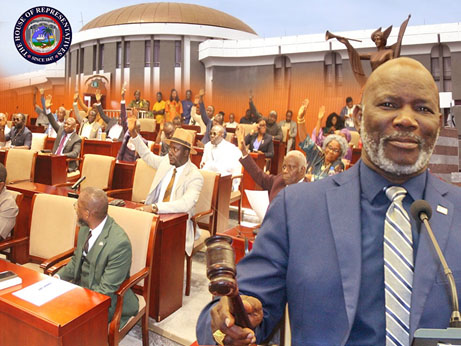
A policy dispute has emerged at Liberia’s National Legislature following the House of Representatives’ passage of the proposed FY2026 National Budget at the aggregate level.
Gbarpolu County Senator Amara Konneh has warned against rushing the process, while a senior budget consultant has pushed back, defending the Executive’s fiscal management.
The controversy centers on President Joseph Nyuma Boakai’s proposed US$1.2 billion budget—the largest in Liberia’s history—submitted to the House on November 7, 2025.
Government officials have described the budget as evidence of improved domestic revenue generation and stronger public financial management.
Senator Konneh, however, has cautioned that a larger budget does not automatically mean a better one.
In a public statement, Konneh praised the Boakai administration for securing a second Millennium Challenge Corporation (MCC) Compact but urged lawmakers to closely examine budget execution, citing shortcomings in the FY2025 fiscal year.
He alleged that discretionary spending and post-approval reallocations weakened the Public Sector Investment Plan (PSIP), potentially violating the Budget Transfer Act of 2008.
According to him, several approved development projects—including airport upgrades, sanitation initiatives, education investments, and revenue authority modernization—received no funding despite legislative approval.
He also cited cases of overspending, including a reported 39 percent budget overrun under the National Service Program, and warned that reallocations away from agriculture and infrastructure undermine the government’s development agenda.
Konneh further questioned the absence of State-Owned Enterprise financial data in the FY2026 draft, a US$13 million increase in the wage bill without clear justification, and a new US$256 million “General Government Expenditure” category with limited detail on oversight.
He criticized the House for approving the budget at the aggregate level, arguing that it weakens legislative oversight and risks poor resource allocation and urged the Senate to conduct a detailed, sector-by-sector review before concurring.
Meanwhile, Budget Consultant S. Emmanuel Lloyd has responded sharply, arguing that Senator Konneh misrepresented lawful budget practices, noting that budget transfers are permitted under Liberia’s public financial management laws and are necessary for operational flexibility.
According to him, FY2025 transfers amounted to roughly 4.5 percent of the total budget—far lower than past years, including FY2012/13, when transfers exceeded 28 percent.
Lloyd defended the reallocations as responses to legitimate obligations such as elections, arrears, defense needs, and health emergencies.
He also defended the General Government Expenditure category, saying it improves transparency by separating centralized obligations like debt service and regional dues from agency budgets.
Lloyd further noted that similar structures existed in earlier budgets, including during Senator Konneh’s tenure as finance minister.
The exchange seems to highlight deeper disagreements over fiscal discipline, transparency, and legislative oversight; especially as the Senate prepares its review, and the outcome may likely influence not only the FY2026 budget but also public confidence in Liberia’s budget management system.
At its core, the debate reflects a larger question: how Liberia balances ambitious development plans with accountability and effective execution?