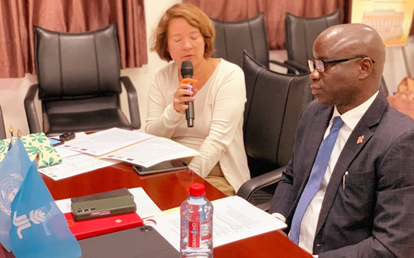
The European Union (EU) has lauded Agriculture Minister Dr. J. Alexander Nuetah, for his visionary leadership and renewed political will to transform the country’s agriculture sector.
The EU also reaffirmed its commitment to support Liberia’s journey toward food self-sufficiency and climate resilience.
At the launch of the Investing in Livelihood Resilience and Soil Health in ACP Countries (ILSA) program in Monrovia, the EU Ambassador, Nona Deprez, praised Dr. Nuetah for revitalizing national and donor coordination in the agriculture sector.
“I really want to laud you. We recognize and appreciate your leadership in moving this sector forward, and for actively pushing us, the development partners, to improve our joint actions and limit waste and duplication,” Amb. Deprez told Dr. Nuetah at the occasion.
According to a release dated November 11, 2025, Amb. Deprez reaffirmed that the EU remains committed to partner with Liberia to strengthen agricultural systems, and promote sustainable growth.
“By investing in soil health and sustainable farming practices, we are not only protecting Liberia’s natural resources, but also empowering farmers, especially women and youth, to lead the country’s transition toward a more inclusive and green economy.”
Deprez added: “This project keeps alive the global climate commitments we made ten years ago in Paris. The €5 million ILSA program, co-funded by the EU, IFAD, and the Government of Liberia, aims to promote soil regeneration, climate-smart agriculture, and resilient livelihoods for smallholder farmers across the country.
Amb. Deprez’s remarks come at a time when Liberia’s agriculture sector continues to face major financing constraints, despite being the backbone of the economy.
Dr. Nuetah also spoke of a recent World Bank report, which credited agriculture as the main driver of Liberia’s 4.0 percent GDP growth in 2024, contributing about 1.3 percentage points, mainly from strong performance in rice and rubber.
Yet, the press release continued, the proposed 2026 national budget allocates only US$13.6 million to the sector, about 1 percent of the total US$1.2 billion budget, far below the 10 percent CAADP benchmark agreed by African leaders.
“Of this allocation, the MoA receives US$9.54 million, the Central Agricultural Research Institute (CARI) US$2.25 million, the Liberia Agriculture Commodity Regulatory Authority (LACRA) US$892,118, the Cooperative Development Agency (CDA) US$848,019, and the Rubber Development Fund just US$132,152.Despite employing more than 60 percent of Liberia’s population, agriculture continues to receive limited fiscal attention,” the release stated,