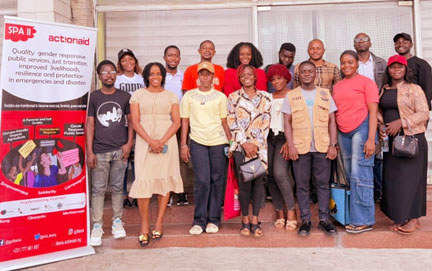
ActionAid Liberia has concluded a two-day capacity-building training aimed at strengthening civil society actors’ understanding of climate change justice, domestic resource mobilization, and the impact of the extractive industry on Liberia’s development.
The training, held over the weekend at the Corina Hotel in Monrovia, brought together young civil society representatives from across the country to deepen their knowledge of climate justice, taxation, and revenue governance, particularly as they relate to vulnerable groups.
One of the participants, Faith K. Kialen, Volunteer Coordinator of the Paramount Young Women Initiative, described the training as an eye-opener. She said prior to the workshop, she had limited understanding of domestic resource mobilization, the country’s financing gaps, and the challenges within Liberia’s extractive sector.
“At the beginning of the training, I did not know much about domestic resource mobilization, its importance, and the challenges we face in the financing gap in Liberia, especially when it comes to the extractive industry and tax equity,” Kialen said.
She noted concerns about inequitable taxation, arguing that poorer citizens, including civil servants, often bear a heavier tax burden than wealthier individuals. “Those who are running the economy have lesser tax to pay than poor people like civil servants, who pay more taxes,” she added.
According to Kialen, the training has equipped participants with the knowledge needed to engage meaningfully in policy discussions and advocacy. “You can’t speak on something when you don’t understand it. You can’t make policy when you don’t understand what you are doing. I see this training as an eye-opener for me,” she said.
Kialen further explained that her organization operates mentoring clubs in 26 schools across four counties and plans to use the knowledge gained to advocate for equitable taxation and climate justice. She said future advocacy efforts will focus on ensuring that taxes are levied fairly and that resources are channeled toward women and girls’ organizations, marginalized communities, and those most affected by climate change.
Another participant, Moses B. Kollie, Program Coordinator of the Rights and Rice Foundation under the Multi-Actor Platform (MAP) Partnership, also praised the training, describing it as timely and impactful.
“On behalf of the Multi-Actor Platform partnership, I want to say thank you to ActionAid Liberia for this training. It has opened our eyes to domestic revenue collection and illicit financial flows,” Kollie said.
He emphasized that climate change interventions require significant financial resources, as the effects disproportionately impact women, youths, and other vulnerable groups. Kollie noted that the Government of Liberia has limited capacity to independently address climate-related challenges.
“Climate change is an immense problem, and we depend largely on the international community to support our climate interventions agenda. With the reduction of support from partners such as USAID and other multilateral institutions, Liberia must now raise its own resources domestically to support its climate agenda,” he stated.
Meanwhile, Norwu Kolu Harris, Climate Justice Lead at ActionAid Liberia, called for greater involvement of civil society actors in national discussions on climate change and the extractive industry.
“It is time for civil society actors to get involved in conversations regarding climate change justice in Liberia,” Harris said.
She urged the government to ensure inclusive engagement and to review existing legal frameworks, particularly the Liberia Revenue Code, to prevent revenue losses. “We are calling on the government to ensure that civil society actors are involved in conversations around the extractive industry and to review current laws to ensure Liberia is not losing much-needed revenue,” she added.