Macpherson C. Marbiah writes
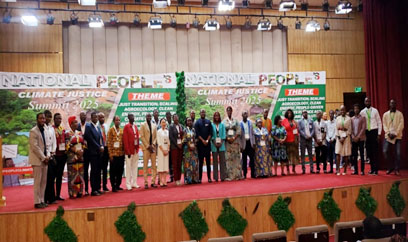
ActionAid Liberia, in collaboration with its local and international partners, has officially commenced the second edition of the National People’s Climate Justice Summit’ in Monrovia.
The two days event will run from Monday, December 15, will end on Tuesday, December 16, 2025.
It brought together more than 900 participants, including climate justice activists, academics, local and international NGOs, human rights defenders, farmers, and renewable energy practitioners.
The Summit is being held under the theme: “Just Transition: Scaling Agroecology, Clean Energy, People-Driven Climate Finance, and Sustainable Solutions for Liberia.”
It underscored the urgent need for inclusive, sustainable approaches to climate resilience and justice.
Each year, the annual National People’s Climate Justice Summit, gathers participants from communities across the country.
They served as a critical platform to amplify public voices on climate change and justice, assess Liberia’s progress and gaps in climate action, drive policy alignment, and advocacy for transformative solutions.
At yesterday’s opening ceremony, ActionAid Liberia Country Director, Madam Elizabeth G. Johnson, said the gathering is not just intended to discussed climate change, but to confront inequality, design and demand a just transition where policies, finance, and technology deliver dignity, resilience and opportunity first to those who bear the greatest burden of the climate crisis.
“Last year, at our inaugural Summit, we collectively lifted a bold agenda: scale agroecology, accelerate renewable energy, and advance people-driven climate finance.”
Madam Johnson indicated that said call to action sparked tangible momentum, deeper engagement between civil society and key ministries, thereby recognizing government commitment to strengthen domestic resource mobilization, including a review of extractive sector concessions.
The aim was to increase contributions to the national budget.
Over the next two days, facilitators will focus on five- interlocking priorities that define a just transition for Liberia.
They include people-driven climate finance, scaling agroecology across the agriculture sector, CAADP accountability with gender and youth-responsive indicators, renewable energy, green jobs and inclusive land access, and disaster preparedness and climate-induced crisis response.
Madam Johnson said, ActionAid’s position is straight-ward on climate justice as social justice.
“It is about power, participation and public accountability, insisting that solutions be community-led, gender-responsive, and rights-based rooted in our feminist principles and human-rights approach. Through the Strategic Partnership for Agroecology and climate Justice in West Africa (SPAC-WA), and Strategic Partnership Agreement II transforming societies to be just, feminist, green and resilient.”
She said ActionAid Liberia stands with the women and youth smallholders’ farmers, by supporting agroecology, land justice, and renewable energy as the levers that simultaneously strengthen food sovereignty, protect biodiversity, cut emissions, and create decent green jobs.
Madam Johnson: “Over the next two days, participants will engage in high-level dialogues and collective sessions, which focuses on developing sustainable climate-finance framework, scaling agroecological practices; strengthening Liberia’s CAADP implementation, expending access to renewable energy, green jobs, and land rights for youth and women, enhancing disaster preparedness and climate-induced crisis response system.
The guest speaker, Deputy Finance and Development Planning Minister for Administration, Bill McGill Jones, said the summit serves as a critical national platform for policy, institutional collaboration, the movement and building together, with women and young people at the center of the transformation of climate justice action in the country, African and globally.
Jones said the theme for this year’s event could not be more-timely than the one being discussed, as climate change is no longer an environmental concern, but a micro-fiscal, developmental and social imperative directly affecting revenue, and fiscal infrastructure, agriculture, productivity and the achievement of the Liberia Agenda for Inclusive Development.
“At the Ministry of Finance, we have recognized the urgency around integrating climate action into the planning process, by establishing and launching the climate integration and financing office, which is charged with the responsibility to oversee all climate related issues, and as well, mobilize resources.”
The unit, Jones said, underscore the Ministry believe that climate financing is not the option, but a necessity for national stability and development.
“As we strengthen our national climate financing framework, it is important to note that Liberia dose not walk this path alone; our progress is grounded in strong international partnership and our share commitment to a resilient and sustainable future.”
Jones spoke about how government is working closely with a number of development partners, whose technical and financial contributions continued to shift policy reforms, strengthen the country institutional capacity and as well support communities.
Both the local and international partners commended ActionAid for hosting the second edition of the ‘National People’s Climate Justice Summit,’ placing strong emphasizes on collaborative actions and multi-stakeholder engagement that underscored the importance of partnerships in government, civil society, activists, communities, the private sector, as well as the international partners to tackle climate change collectively.
Macpherson C. Marbiah writes/0777250370-0886442881